Introduction
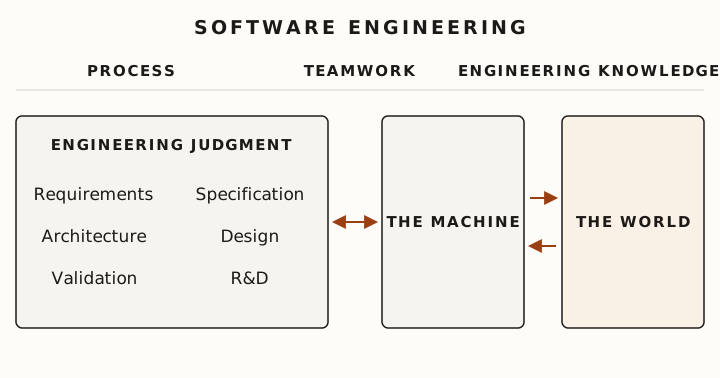
This handbook covers software engineering, process, teamwork, engineering knowledge, requirements, specification, architecture, design, validation, and research and development. The chapters follow a linear sequence to show the shifting concerns of engineering work, as well as the judgments that are sustained throughout the process. Real engineering is less orderly. Requirements change as engineers learn, design can expose architectural problems, and validation can reopen earlier decisions.
In this handbook, I make one change to the usual sequence of engineering work. Research and development (R&D) typically occurs near the beginning, but we place it at the end. R&D asks engineers to decide where scarce effort should go when they do not yet know what is possible, whether an obstacle requires a genuinely new idea, and what evidence would establish an advance. These decisions are difficult to appreciate without some engineering experience. By the end of the handbook, the reader will have developed more of the judgment needed to understand them.
How to read this book
Each chapter follows a recurring pattern. It first develops a conceptual model for a consequential part of software engineering: the distinctions, relationships, and alternatives an engineer must understand. It then elaborates that model by identifying the decisions engineers face, what alternatives are available, and what consequences distinguish them. The purpose is to make engineering judgment explicit enough to study and practice.
Near the end of each chapter, we ask how measurement can support those decisions. An engineering model implies properties, expectations, or predictions about the systems and organizations it describes, and observation can supply evidence about whether those expectations hold. Measurements do not make engineering decisions by themselves. They make some part of reality observable, so that engineers can compare what a model led them to expect with what actually occurred. The chapters therefore share a recurring reasoning pattern:
Model → Property → Observation → Evidence → Judgment
The chapters do not provide algorithms for making these decisions. Engineering judgment is necessary precisely because consequential decisions usually involve competing considerations, incomplete knowledge, imperfect measurements, and uncertainty. Instead, the chapters identify what deserves attention, provide ways to reason about it, and develop the evidence from which a defensible decision can be made. A metric is itself a model connecting a property we care about to something we can observe, so engineers must judge not only what to measure, but what the measurement means, what it omits, and whether the resulting evidence should change the decision.
A note about metrics
Metrics appear throughout this book. Engineering decisions are made under uncertainty, and measurement is one of the principal ways engineers turn observations into evidence. Whenever something matters, we can ask: What could we observe or measure that would tell us something about it? The answer may be straightforward for properties such as latency or memory consumption. It becomes more difficult for properties such as maintainability, productivity, usability, team health, or delivered value.
Choosing a metric is itself an engineering judgment. A metric is a model: it represents some property of interest through something we can observe or measure. That representation is necessarily incomplete. Engineers must ask what a metric captures, what it omits, what assumptions connect it to the property of interest, and what other evidence should accompany it. Almost no consequential engineering decision can be reduced responsibly to a single metric. Measure the property at the scope where it matters.
Metrics can also change the systems they measure. Once a measurement becomes a target, people and systems may optimize for the measurement rather than the underlying property, an observation commonly associated with Goodhart’s Law. Later chapters show concrete examples of metrics that under-explain a property, mislead decision-makers, or invite gaming. The lesson is not to avoid measurement, but to treat the selection, interpretation, and combination of measurements as part of engineering judgment.