Chapter 4: Engineering Knowledge
How should what engineers learn persist?
Premise. Software engineering depends on knowledge that must outlive the people, systems, and circumstances in which it was discovered.
Teamwork lets engineers combine capabilities that no individual possesses alone, but coordination in the moment is not enough. People forget and leave teams. Specialists know different parts of a system. Decisions made in one year constrain engineers working years later, while production failures can reveal facts nobody knew when those decisions were made. An engineering organization therefore needs memory.
This problem is particularly important because software is the engineering discipline of change. The artifact changes, and so does the environment in which it operates. A representation created yesterday may already describe an earlier version of the system. That does not make the representation useless. It means engineers must judge what it still tells them and how much weight it deserves in the decision they face now.
Knowledge management is therefore not the task of documenting everything. It is a problem of engineering judgment:
What should the organization remember, in what form, and with how much confidence?
Engineering knowledge
Engineering knowledge is information about a system, its environment, or the decisions surrounding it that can support future engineering judgment.
A developer discovers that a third-party service silently throttles requests above a particular rate. That observation becomes engineering knowledge when it can inform future decisions about batching, retries, capacity, or replacement of the dependency.
Engineering knowledge includes facts about the artifact, but it is not limited to them. Engineers also need to know why decisions were made, which assumptions supported them, what alternatives were rejected, what happened when a system encountered the world, and what remains uncertain. Knowledge management is the deliberate acquisition, representation, preservation, use, and revision of such knowledge when it may matter to future engineering decisions. Recording why a database was selected, retaining the measurements that supported the choice, and later reconsidering the decision when workload assumptions change are all knowledge-management activities.
Engineering organizations must remember
An engineering organization can know more than any person in it. One engineer may understand why a subsystem has an unusual interface, another which customer workflow motivated it, and another the production incident that caused a particular safeguard to be added. Nobody needs to know everything. The organization needs to be able to recover the relevant knowledge when a decision requires it.
That capability is distributed across people, representations, tools, and the relationships among them (Hutchins 1995). An engineer may not personally know why a constraint exists, for example, yet still make a sound decision because the constraint is visible in a specification, embodied in an interface, or enforced by a check. What the organization can know and do therefore depends partly on how knowledge is distributed through its engineering environment.
Without some form of engineering memory,1 that distributed knowledge decays with the conversations and people that carried it. Engineers rediscover old constraints, repeat experiments, reopen settled arguments without knowing why earlier alternatives were rejected, or remove peculiar-looking mechanisms whose purpose has become invisible. The cost appears later as repeated work and decisions made without information the organization once possessed.
Preserving knowledge is not free either. Someone must record it, organize it, find it, interpret it, and sometimes maintain it as the system changes. A repository containing every conversation, intermediate thought, measurement, and obsolete plan might preserve enormous amounts of information while making useful knowledge harder to find.
The engineering problem is therefore selective:
What will future engineers regret having to rediscover?
Consequential knowledge, frequently reused knowledge, expensive discoveries, and decisions with long-lived effects are stronger candidates for preservation; ephemeral details whose rediscovery is cheap are weaker ones. The purpose of engineering memory is not to preserve everything. It is to reduce consequential rediscovery.
Engineering knowledge comes from many places
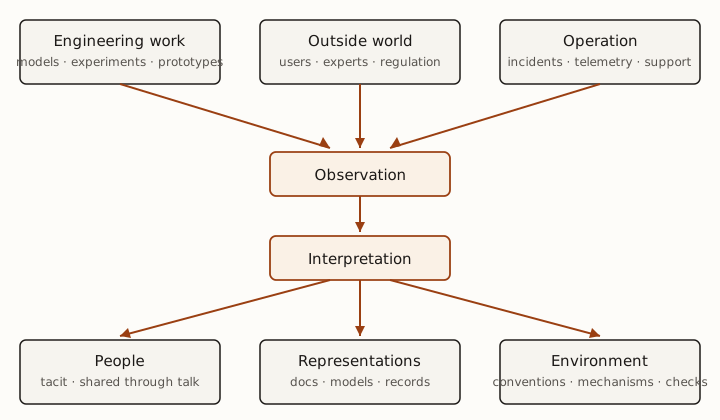
Engineering organizations learn continuously. Some knowledge comes from deliberate engineering activity. Some arrives from outside the engineering organization. Some is supplied by the behavior of the system itself.
Internal engineering work
Engineering produces information as well as artifacts. A prototype can reveal that a proposed mechanism is too slow; a dependency analysis can expose unexpected coupling; a design exercise can reveal an assumption that architecture left unresolved. Code review, experiments, measurements, and implementation itself similarly teach engineers about the system they are constructing.
Unsuccessful work can be valuable for the same reason. A rejected design may establish why an apparently attractive approach fails under an important constraint. Preserving the reasoning can prevent a future engineer from paying the same cost to rediscover the same limit.
Stakeholders and the external environment
Knowledge also enters from outside the engineering organization. Customers describe problems and workflows; users report confusing behavior; regulators impose obligations; domain experts explain facts about the world the software represents. Contracts establish commitments, suppliers change interfaces, standards evolve, and changing technologies alter what solutions are feasible.
These inputs do not arrive as perfectly formed engineering truths. A customer request may describe a proposed solution rather than the underlying need. Two users may want incompatible behavior. A regulation may require interpretation; a domain expert may be mistaken; an external dependency may behave differently from its documentation. Engineering therefore has to interpret external knowledge before deciding what consequences it should have for the system.
Operation, failures, and incidents
Once software operates in the world, its behavior becomes another source of knowledge. Measurements reveal workloads that estimates did not predict. Support cases reveal workflows designers did not anticipate. Security reports expose assumptions attackers can violate, while failures reveal combinations of circumstances that design-time reasoning missed.
Incidents are especially valuable because they provide evidence about assumptions the engineering organization actually made. A timeout may expose an unrealistic latency assumption. Data loss may reveal that two components disagreed about which held authoritative state. A deployment failure may expose a dependency missing from the architectural model. Repairing the immediate failure restores service; learning from it asks what the incident revealed about the organization’s previous understanding.
An incident is therefore not only something to repair. It is an opportunity to learn what the organization misunderstood.
Observation is not yet engineering knowledge
A customer complaint, benchmark result, incident, engineer’s intuition, or regulatory interpretation is an input to engineering judgment. It does not automatically establish what is true or what engineers should do.
Ask what the observation supports, what alternative explanations remain, how broadly the lesson generalizes, and whether it is consequential enough to affect future decisions. Capturing inputs without interpreting them can preserve information without producing useful engineering knowledge.
Not everything should be remembered
Once engineers recognize knowledge as valuable, preserving more of it can seem obviously beneficial. Past a point, the strategy defeats itself. Documents must be searched and interpreted; models compete for attention; old decisions must be distinguished from current ones; contradictory records require reconciliation. Material that nobody trusts becomes another body of information future engineers must search and assess before they can act.
Capturing knowledge also creates maintenance costs. A representation intended to describe the current system may require revision as the system evolves. The more representations an organization creates, the more relationships it may need to maintain among them.
Whether knowledge deserves durable representation therefore depends on its expected future value.
Should this knowledge persist?
Ask:
- What happens if it is forgotten? Forgetting the command used for a one-time migration may be harmless. Forgetting why a safety check exists may not be.
- How likely are engineers to need it again? Recurring decisions justify more durable treatment than genuine exceptions.
- How expensive would rediscovery be? A two-minute experiment may be cheaper to repeat than maintain. Months of investigation are different.
- How many future decisions could it affect? A local implementation detail may affect one engineer; a system-wide constraint may affect hundreds of changes.
- What will preservation cost? Capturing, finding, interpreting, revising, and reconciling knowledge also consume engineering capacity.
The question is therefore not simply whether something is worth knowing. Engineers must compare the expected value of future use against the cost of making the knowledge persist.
The retrieval side of that cost is not fixed. Finding recorded knowledge is an old problem, pursued for decades as information retrieval and enterprise search. Language models and the agents built on them have made retrieval over unstructured historical material capable enough that knowledge once preserved but effectively unfindable may now be reachable. That capability demands care. A system that answers plausibly from stale, contradictory, or superseded records makes confident wrong answers cheaper to produce.
Knowledge can be represented with different strengths
Knowledge can persist through people, communication, representations, or the engineering environment. These forms make different tradeoffs. Tacit knowledge held by an experienced engineer can be rich and adaptable, but access depends on that person. Conversation spreads knowledge among people, but the resulting shared context can disappear as membership changes. Explicit representations such as prose, diagrams, models, requirements, measurements, runbooks, and decision records survive the original conversation, although every representation selects some facts and omits others.
Recurring knowledge can also be incorporated into the engineering environment. A recurring decision may become a convention or shared library. A recurring mistake may become a static check. An obligation may become an automated test or control. Future engineers no longer need to retrieve the lesson from another person’s memory before benefiting from it; they encounter the accumulated knowledge in the environment in which they work.
These forms do not constitute a maturity ladder. A conversation may be exactly right for an ephemeral issue, while prose may preserve rationale that would be meaningless as an automated rule. A model can expose relationships that prose obscures. Automation is useful only when the underlying knowledge is stable and precise enough to support it. The appropriate representation depends on how the knowledge is expected to be used.
Knowledge can move
A lesson may begin in one engineer’s experience, become shared through conversation, be represented in a document or model, and eventually become a convention or automated control.
Move knowledge when the expected benefit of making it more durable, discoverable, precise, or enforceable exceeds the cost.
Knowledge graphs and engineering agents
Documents are not the only way to represent engineering knowledge. A knowledge graph represents entities and relationships explicitly: a component depends on a service; a requirement constrains an interface; a test provides evidence for a claim; a decision supersedes an earlier decision. Graph structure makes relationships available for traversal and computation rather than leaving them implicit across prose and files.
This possibility has become more consequential with engineering agents. A human engineer can often reconstruct relationships by reading several documents and using experience to connect them. An agent likewise benefits when important relationships are represented explicitly rather than requiring them to be repeatedly inferred from text. Knowledge graphs can therefore serve as part of an engineering environment through which both humans and agents retrieve context, follow dependencies, and identify relevant knowledge.
A graph does not solve the knowledge-management problem by itself. Its nodes and relationships can still be incomplete, stale, ambiguous, or wrong. The same questions developed in this chapter still apply: Where did this knowledge come from? What claim does it support? How current is it? And how much weight should an engineer or agent place on it?
Representations are evidence, not reality
Every representation leaves something out. A dependency graph omits details irrelevant to dependencies; an architectural diagram selects relationships at a particular level of abstraction; meeting notes preserve a summary rather than the meeting itself. This selectivity is what makes representations useful. A representation that reproduced reality in every detail would offer little reduction in the reasoning required to understand it.
Software adds another complication because the represented system keeps changing. Suppose an architectural diagram accurately describes a system when it is created. Engineers later add dependencies, split components, introduce caches, replace services, and create exceptions. The diagram rarely becomes false at one identifiable moment. Its relationship to the current system instead becomes increasingly approximate.
Approximation does not erase the diagram’s value. It may remain excellent evidence of the original architecture, explain why interfaces have their present shapes, preserve terminology still used by the team, or reveal the organizing idea from which the current system evolved. None of those uses establishes that it still describes every current dependency.
A representation can remain useful as it drifts from current reality, but the weight engineers place on it should reflect its fidelity to the claim being considered now.
This is a routine problem rather than an exceptional failure of documentation. Software is built to change, so engineers routinely make present decisions using knowledge produced under earlier conditions. The relevant question is not simply whether a representation is “up to date.” It is what claim the engineer is trying to support, how the representation was produced, and what relevant parts of reality have changed since then.
Provenance helps answer that question:
- Who produced this representation?
- When was it produced?
- What observations or evidence supported it?
- What purpose was it intended to serve?
- What claim did it actually make?
- What relevant conditions have changed since then?
- What incentives or interests may have shaped what was recorded?
- What claim are we trying to support with it now?
These questions do not produce a mechanical confidence score. They establish the context in which an engineer can judge how much evidentiary weight a representation deserves for the particular decision at hand.
One document, different evidence
Consider an architectural diagram created in 2023 showing a payment service as three components: an API, a payment processor, and a database. By 2026 the system has added a queue, a fraud service, and direct reporting access to the database.
The diagram remains strong evidence of the decomposition the architects intended in 2023 and may explain why several interfaces still look the way they do. It is weaker evidence about today’s dependency structure and provides almost no evidence that the workload assumptions behind the original architecture remain valid. The document did not suddenly become useless when the first change occurred. Different claims simply require different evidence.
Age does not determine usefulness. The claim being made determines the evidence required.
Records are not neutral
Representations are also produced by people inside organizations. Those people have incomplete information, interpret events differently, possess different authority, and may face incentives that affect what gets measured, estimated, emphasized, or recorded. Engineering records therefore carry the circumstances of their production along with their technical content.
Records are not neutral
Engineering records are created by people inside organizations. They may be incomplete, mistaken, selective, optimistic, politically convenient, or occasionally deliberately false. Estimates can reflect incentives as well as forecasts. Meeting notes reflect what the recorder noticed, understood, and chose to preserve. Decision records may describe a cleaner rationale than the one that actually produced the decision. Representation gives knowledge persistence. It does not give it truth.
Records can also acquire audiences their authors never anticipated. Internal messages, estimates, meeting notes, design discussions, and incident records may later be read by executives, auditors, regulators, courts, journalists, or legislators. This is not an argument for avoiding records or disguising uncomfortable facts. Engineers should distinguish observation from interpretation, preserve material uncertainty and disagreement, attribute decisions accurately, and write records that can fairly explain what was known and decided at the time.
Who records a decision influences what the organization later remembers about it. Treat that influence as an engineering responsibility.
The appropriate response is neither cynicism nor blind trust. It is the same response engineers apply to other evidence: understand its provenance, understand what claim it supports, and calibrate the weight placed on it.
Engineering knowledge has a lifecycle
Representing knowledge is not the end of knowledge management. A useful simplified lifecycle is:
Observe → Interpret → Represent → Use → Reassess
A production incident reveals that an upstream service sometimes takes thirty seconds to respond. Engineers first observe the timeout pattern, then interpret it as evidence that an assumed latency bound is unsafe. They represent the conclusion in a dependency record and establish a timeout policy. Future engineers use that knowledge when designing calls to the service. If the dependency or its service-level guarantees later change, the organization must reassess whether the old conclusion still deserves authority.
The lifecycle matters because engineering knowledge is acquired under particular circumstances and later used under circumstances that may differ. Measurements describe workloads that may change; design decisions depend on assumptions that may disappear; customer needs evolve; new evidence may contradict earlier conclusions.
Reassessment does not always mean revision. Historical knowledge can remain useful precisely because it describes the past. An old decision record may no longer govern the current architecture while remaining the best explanation of why the architecture evolved in a particular direction.
It is therefore useful to distinguish historical value from current authority. Superseding an engineering record need not mean deleting it. Future engineers may need both the current decision and the history that explains how the organization reached it. Conversely, preserving an old record without making its changed status visible can be dangerous. An engineer may reasonably treat an apparently current runbook, requirement, or architectural rule as authoritative when the organization no longer does.
Good engineering memory requires both remembering and knowing what no longer deserves authority.
Consequential knowledge should change engineering
The strongest evidence that knowledge matters is often that engineers keep needing it, and repeated rediscovery is evidence about the representation as much as about the knowledge. A fact that engineers continually reconstruct may need to become easier to find. An explanation repeated to every new team member may deserve durable representation. Repeated mistakes can indicate that documentation is too weak a form for the knowledge being preserved. When incidents repeatedly expose the same assumption, the organization may need to change the engineering environment rather than remind engineers of the lesson again.
Consequential knowledge can therefore migrate into more durable engineering structure, and the appropriate destination depends on what future decision the knowledge should constrain. Some knowledge becomes a requirement because it describes what stakeholders need from the system. Some becomes specification because engineers must make acceptable behavior precise. Some becomes architecture because later engineering should inherit a consequential organizational decision. Some becomes a design convention or shared mechanism because engineers should not repeatedly solve the same local problem. Some becomes validation evidence or a continuing check because the organization needs grounds for believing that an important claim remains true. Choosing among those destinations requires understanding what kind of engineering decision the knowledge should support; the remaining chapters develop those decisions in turn.
Learning should sometimes change how future engineering is performed. An organization that repeatedly experiences the same surprise without changing what it remembers, represents, or does has collected experience without accumulating much engineering knowledge.
Failure-Aware Engineering returns to this problem from the other direction: when reality contradicts what engineers expected, how should the resulting experience become engineering knowledge that changes the system, the organization, and the engineer?
Measurement for decision-making
An organization can hold large quantities of recorded information while remaining poor at remembering. The property of interest is not how much has been stored, but whether consequential knowledge becomes available in a usable form at the moment an engineering decision requires it.
Parts of that process can be observed. Engineers can measure how long it takes to find the information needed for a decision, how often existing knowledge must be rediscovered through fresh investigation, and how frequently supposedly current records contradict the implemented system. Failure records deserve particular attention here, because they preserve cases in which reality contradicted an earlier understanding. When an incident repeats a lesson the organization has already encountered, that recurrence is evidence about the knowledge lifecycle itself: the earlier lesson was not represented durably enough, not retrievable when it mattered, not recognized as applicable, or not applied.
A second useful question is whether represented knowledge can be traced to the artifacts it is supposed to govern. Which code realizes this architectural decision? Which implementation depends on this environmental assumption? Which tests supply evidence for this requirement? Performing that tracing by hand is expensive and feels to engineers like pure overhead, which is why it is usually not done. Language models can now search across prose, code, specifications, issue histories, and tests to propose these links at far lower cost. A proposed link is evidence, not ground truth. But cheap proposals make it practical to inspect whether consequential knowledge actually reaches the work it was meant to influence.
These remain proxies. Search latency does not measure knowledge quality, document counts do not measure organizational memory, and an automatically inferred link does not establish that two artifacts are correctly related. Even apparent reuse can faithfully preserve an incorrect lesson. The model developed in this chapter therefore remains necessary: engineers must weigh the source, representation, strength, currency, and consequences of knowledge rather than counting its artifacts.
Used with that caution, measurement can nevertheless show where the lifecycle is breaking down. Repeated rediscovery, decisions no one can locate, records that have drifted from the system they describe, and recurring violations of lessons already learned are all evidence that consequential knowledge is not surviving in a form strong enough to influence future engineering.
Summary
Engineering organizations learn from many sources. Engineers discover facts through design, implementation, modeling, experiments, and measurement. Stakeholders and the external environment supply needs, constraints, claims, and changes. Deployed systems supply observations through normal operation, failures, and incidents. None of these inputs interprets itself.
Knowledge management determines which lessons deserve to persist and how they should be represented. Tacit understanding, communication, documents, models, conventions, mechanisms, and automated controls provide different combinations of richness, durability, discoverability, precision, and authority. More durable representation is valuable only when its future benefit justifies its cost.
Representations are evidence rather than reality. They abstract, they age, and the systems they describe evolve. Their usefulness need not disappear as they drift from current reality, but the weight placed on them should reflect their provenance and their fidelity to the particular claim under consideration. Representation also does not guarantee truth: organizational incentives, incomplete information, interpretation, and authority affect what gets recorded.
Engineering knowledge therefore has a lifecycle. Engineers observe, interpret, represent, use, and reassess what they know. Consequential recurring knowledge should sometimes become part of the structure within which future engineering occurs.
Engineering knowledge lets yesterday’s learning reduce today’s rediscovery. The next question is what the system ought to accomplish in the first place.
Read Further
Hutchins, Edwin. “How a Cockpit Remembers Its Speeds.” Cognitive Science 19, no. 3 (1995): 265–88. https://doi.org/10.1207/s15516709cog1903_1. The canonical demonstration of distributed cognition across people, procedures, instruments, and representations.
Rus, Ioana, and Mikael Lindvall. “Knowledge Management in Software Engineering.” IEEE Software 19, no. 3 (2002): 26–38. https://doi.org/10.1109/MS.2002.1003450. Introduces knowledge management as a software-engineering problem of creating, sharing, and preserving organizational knowledge.
Hansen, Morten T., Nitin Nohria, and Thomas Tierney. “What’s Your Strategy for Managing Knowledge?.” Harvard Business Review 77, no. 2 (1999): 106–16. https://hbr.org/1999/03/whats-your-strategy-for-managing-knowledge. Contrasts codifying knowledge with connecting the people who possess it.
Hogan, Aidan, Eva Blomqvist, Michael Cochez, et al. “Knowledge Graphs.” ACM Computing Surveys 54, no. 4 (2021). https://doi.org/10.1145/3447772. A comprehensive survey of knowledge graphs as explicit, processable representations of entities and relationships. Read the introductory material and the sections on representation rather than the entire survey.
-
Engineering memory is sometimes called institutional knowledge, but the terms name different things. Engineering memory concerns the system: what the organization retains about the artifact it builds and operates. Institutional knowledge concerns the organization producing it, including its people, processes, and norms. The two overlap, because how an organization worked often explains why its system took the shape it did. ↩