Chapter 9: Validation
Premise. Validation asks what evidence is sufficient to deliver a software system into the world.
Engineering decisions flow from purpose through requirements, specification, architecture, design, and implementation. At each point, engineers make choices for which they are responsible. Eventually those choices produce software that can be delivered. The engineer must then decide whether there is enough reason to proceed.
This makes validation broader than testing. Tests are one way to obtain evidence about a system, but the engineering question comes first: What must we know before we are willing to deliver it? A review may provide useful evidence about a design. Static analysis may provide evidence about possible program behaviors. Measurement may establish whether a performance objective has been met. A proof may establish a property under stated assumptions. Different claims require different evidence.
Nor does validation necessarily seek certainty. Software is unusually updateable. Software Engineering showed how an engineer can change one codebase and propagate the result across an enormous deployed population. The same property that spreads mistakes makes repairs cheap to distribute. Process drew one consequence: when a decision is cheap to reverse, engineers can experiment rather than spend more avoiding an error than correcting it would cost.
The same reasoning applies to delivery. Sometimes it is better to deliver software with known uncertainty, observe what happens, and revise it. A game can ship with an occasional graphical defect. An internal tool can be useful despite awkward workflows. A consumer application may need to reach users before its engineers can learn which capabilities people actually value. In these cases, delaying delivery until every known uncertainty has been resolved can cost more than learning from use.
In that limited sense, move fast and break things describes a real engineering strategy. It is not always irresponsible to deliver software that might fail. The engineering question is whether failure after delivery is an acceptable way to learn.
That qualification matters because software’s updateability can repair the software, but not necessarily the consequences of its previous behavior. An update can correct a graphical defect after players encounter it. It cannot necessarily recover money already lost, make disclosed information private again, or reverse a physical injury. As the consequences of being wrong become more substantial or less reversible, learning through failure becomes more expensive.
Process deliberately left the consequence of failure out of its model for organizing engineering work. Consequence does not tell us whether requirements can be known in advance, whether a decision is expensive to reverse, or whether a partial system can be built and validated. It answers a different question: How much assurance should we demand before delivery?
That is the question of this chapter.
Acceptance is a professional judgment
Consider three software defects. A game sometimes draws a character incorrectly. A TODO application occasionally loses a task. A medical device can sometimes deliver an incorrect dose.
These defects differ in more than severity. The game defect may directly annoy a player, but more serious consequences require a longer causal chain. The TODO application destroys information on which a user may depend: the lost task might cause a missed appointment or deadline. The medical device can directly injure its user. The more substantial and direct the possible consequence, the stronger the reason to reduce uncertainty before delivery.
Causal distance matters because almost any software behavior can be connected to serious harm through a sufficiently long chain. A broken game may frustrate a player, and frustrated people sometimes behave badly. That possibility does not make an ordinary graphical defect safety-critical. Engineers must reason about consequences substantial and direct enough to matter to the delivery decision.
This does not imply that consequential systems must be perfect. Engineering rarely offers certainty, and useful systems can carry residual risk. Nor does consequence mechanically determine an acceptable level of risk. Two people can agree completely about what might happen and disagree about whether the available evidence justifies delivery.
Suppose everyone agrees that a particular failure could kill people. The organization building the system may understand that consequence and nevertheless judge the residual risk acceptable because of the benefit the system provides. A regulator may permit the system on the same understanding. An engineer may still conclude that the available evidence is insufficient to justify delivery.
The disagreement is not about what the consequence is. It is about what that consequence requires.
Three things therefore contribute to the standard applied at delivery. Consequences establish what is at stake if the engineering judgment is wrong. Stakeholders judge what outcomes, costs, and risks they are willing to accept. Engineers exercise independent professional judgment about what the available evidence allows them to stand behind. These judgments often agree, but none substitutes for another.
The last judgment takes us to professionalism. Engineers do not act only as employees carrying out the preferences of whoever controls a project. They are also members of a profession.
Professionalism
Professionalism is the exercise of specialized capability under obligations that are not reducible to the wishes of whoever asks you to use it.
A customer may be willing to accept a structural risk that an engineer judges inadequately understood. The customer’s willingness does not require the engineer to certify the structure. The same distinction applies to software: another party may have authority to accept a risk without determining what an engineer can responsibly claim about the system or requiring the engineer to participate in its delivery.
A profession exists partly because specialized decisions cannot always be made well by the people who want the resulting system. Society relies on physicians to exercise medical judgment rather than merely supply requested treatments, and on engineers to exercise engineering judgment rather than merely realize requested artifacts. Professional communities accumulate standards, methods, experience, and expectations about what their members should stand behind. Engineers draw upon that accumulated judgment when exercising professional authority.
Professional judgment is therefore different from personal preference. Suppose a customer needs a disposable internal tool by Friday. Its failures have minor consequences, and the customer can tolerate occasional errors. An engineer might prefer to spend another six months making the software extraordinarily reliable. That preference does not make the additional work good engineering. Resources spent eliminating inconsequential uncertainty cannot be spent elsewhere.
The opposite error is more serious. Suppose a system can kill people when it fails. The customer wants to proceed, but the engineer believes the available evidence does not justify delivery. The customer’s willingness to bear the risk does not end the engineer’s responsibility. The engineer may need to obtain stronger evidence, change the system, defer to someone with the necessary competence, or refuse the work.
These cases expose two pathologies. An engineer can demand substantially more assurance than the consequences and stakeholder needs warrant, pursuing perfection at unjustified cost. Or an engineer can demand less assurance than the consequences warrant and deliver work they should not stand behind. Good engineering lies in neither direction. It seeks a defensible standard for the decision actually being made.
The relationship can be summarized as follows:
| Engineer accepts a lower standard | Engineer demands a higher standard | |
|---|---|---|
| Consequences are substantial | Professional failure. The engineer’s standard is inadequate to what is at stake. | Appropriate rigor, when the additional work materially reduces consequential uncertainty. |
| Consequences are minor | Often appropriate. Good enough may actually be good enough. | Overengineering, when additional assurance consumes resources without commensurate value. |
This table intentionally simplifies the stakeholder’s role. Stakeholders help determine what the software must accomplish and which ordinary failures they are willing to tolerate. They may also participate in broader decisions about acceptable risk. The table isolates a different question: whether the engineer’s standard is appropriate to the consequences they understand.
Professional authority matters most when these judgments diverge. A customer, employer, regulator, or government may be willing to accept a risk that an engineer will not. That willingness does not erase the engineer’s responsibility for their engineering judgment. The engineer may refuse to certify the result and ultimately refuse to use their professional capabilities to produce or deliver it.
This does not put engineers above society. Engineers do not acquire general authority over what purposes other people may pursue merely because those purposes involve technology. But political, organizational, and economic authority do not replace engineering judgment. Others can make decisions within their authority. They cannot give an engineer evidence the engineer does not possess or make defensible a judgment the engineer cannot defend.
Professional authority therefore includes the ability to say no.
Validation makes this responsibility especially visible because delivery requires a decision. But professional responsibility does not begin there. An engineer who recognizes a dangerous omission in the requirements cannot knowingly preserve it on the theory that validation will catch it later. The same is true of an indefensible specification, architecture, or design. Each engineering activity carries responsibility for its decisions.
Validation is nevertheless special because earlier decisions meet evidence there. Requirements establish what the effort promised; specification represents the machine properties and environmental assumptions needed to keep those promises; architecture and design represent the organization, mechanisms, and local properties through which they will be realized; implementation produces the realized system.
These models become progressively more specific toward implementation, but they do not merely restate the same properties at finer levels of detail. A specification might require a request to complete within 500 ms; an architectural model allocates that time across a path of interacting services; a design might hold one worker below 4 GB of memory. Other properties concern correctness rather than quantities: a payment may be charged at most once, a dependency may not cross a boundary, and a retry mechanism may need to be idempotent.
Validation asks whether the realized system provides sufficient evidence for the properties on which those engineering decisions depended. Evidence can confirm a model, expose a defect in the realization, show that an assumption was wrong, or reveal that the model itself omitted something consequential. What engineers learn therefore flows back through the decisions that constrained realization.
The distinctive question at validation is whether the resulting evidence is enough to deliver.
Consequence changes the amount of evidence we should demand
What could happen if the delivery decision is wrong? Suppose a TODO application loses one task in every thousand. A personal scratchpad may tolerate that loss; a task system coordinating emergency maintenance may not. The same failure rate can justify different decisions because the consequences differ.
Consequence
A consequence is an effect in the world that can result from an engineering decision or system behavior.
Consequences give engineers reason to demand more or less assurance, but do not determine a unique threshold for delivery. Someone must still judge what evidence is sufficient.
Evidence obligations should reflect consequence. Not every property deserves the same validation effort. A specification can identify some obligations as more critical than others, including groups of obligations with their own internal priorities (“Prioritizing specification effort”). The stronger the consequence of violating an obligation, the stronger the evidence we should ordinarily demand before relying on it. This relationship is not mechanical: criticality can depend on operating context, obligations can be incomparable, and finite evidence never eliminates uncertainty. Later, when we examine failure, we will turn the relationship around. The criticality of the violated obligation and the resulting consequence help determine the severity of a failure (Failure-Aware Engineering).
That judgment changes as engineers learn. Before delivery, a harmful outcome may be only a possibility supported by stronger or weaker evidence. Delivery produces new information: engineers observe failures, measure outcomes, receive user reports, and discover consequences they did not predict. This is one reason delivery under uncertainty can be valuable when possible consequences are modest: use generates knowledge that might have been expensive or impossible to obtain beforehand.
But new evidence changes the engineering decision. Suppose engineers initially believe a deployed feature is unlikely to cause substantial harm. Later evidence indicates that it does. The original justification cannot simply be reused. Continuing the same behavior is a new decision made with different knowledge.
This distinction is especially important because software can often be updated quickly across a deployed population. That capability makes learning after delivery more practical, but also makes learned evidence harder to ignore. If engineers know that deployed behavior is causing substantial harm and can change it, continued operation requires justification under the new state of knowledge.
Validation therefore does not end with the first delivery. Evidence continues to flow from the deployed system, and consequential new evidence should trigger reconsideration of the decisions it bears upon.
The question remains the same even as the evidence changes: Do we know enough to justify what we are about to deliver?
The next step is to make know enough precise. Before choosing tests, analyses, reviews, or other validation techniques, engineers must identify what they are trying to establish.
Identify the claim
Before choosing a validation technique, identify the claim that needs support. Saying that a system has “been tested” tells us little until we know what the tests were intended to establish.
A payment service might need to support several claims: a payment submitted once should not be charged twice; an unauthorized user should not be able to initiate a payment; a completed payment should appear in the account history; a normal request should complete within an acceptable time. Each claim concerns the same system, but evidence supporting one may say little about another.
The claim therefore comes before the technique. Identify what must be believed, consider how the system could violate that claim, then seek evidence capable of distinguishing acceptable from unacceptable behavior. If the claim concerns duplicate charging, engineers need evidence capable of exposing duplicate execution under the conditions in which it might occur. If the claim concerns latency, they need measurements under relevant workloads and environments. If the claim concerns behavior over all possible values of some bounded input, exhaustive analysis or proof may provide evidence that ordinary examples cannot.
Validation techniques can then be understood as solutions to recurring evidence problems. Fuzzing is useful when engineers can cheaply search many executions and recognize some failures with a weak oracle. Property-based testing is useful when individual expected results are expensive to enumerate but a property can be stated across a class of executions, including a property that relates one execution to another when no individual answer is available. Model checking is useful when reasoning over possible modeled behaviors can establish something that sampling executions cannot.
Learning these techniques matters, but knowing how to perform them does not determine which evidence an engineering decision requires. What engineers need to know determines which techniques can provide useful evidence.
Validate at the scope of the property
Engineering models represent properties at different scopes. A design may depend on a property of one mechanism or component. An architecture may depend on a property of several parts together. A specification constrains behavior at the machine boundary and states the assumptions under which that behavior should establish a requirement. Requirements concern the resulting outcomes in the world.
Validation must therefore obtain evidence at the scope where the property exists. Establishing every component’s local properties does not establish every property of their composition. Three services can each satisfy their local latency budget while communication and queueing cause the end-to-end path to exceed its system budget. Two components can each behave correctly under their own assumptions while their assumptions leave an important responsibility to neither. Two services can each implement retries correctly while their interaction permits the same operation to occur twice.
This relationship gives the familiar V-shaped picture a useful engineering interpretation. The left side does not prescribe a sequence in which engineers must complete Requirements before Specification, Specification before Architecture, and so forth. Process already showed why engineering activities may be interleaved. Instead, the left side represents increasingly specific engineering decisions as models constrain a realization; the right represents evidence about the corresponding properties at progressively broader scopes.
The familiar terms unit testing, integration testing, system testing, and acceptance testing describe common scopes of validation. Unit testing usually examines a chosen part in isolation; integration testing examines interactions among parts; system testing examines an assembled system at a chosen boundary; and acceptance testing asks whether the resulting system is acceptable for its intended use. These terms are useful professional vocabulary, but their boundaries depend on context. A subsystem may be treated as a unit from one perspective and as a system with its own internal architecture from another.
The scope of validation should therefore follow the property being established, not a predetermined testing level. Architecture and design progressively refine the machine until it can be realized as an implementation (Design). There need not be one architectural level followed by one design level. A system may contain subsystems, components, services, modules, and mechanisms, with consequential properties introduced at each scope. Validation follows that structure in reverse. Local evidence can establish local properties, while properties arising from interactions require evidence about those interactions. Properties of the machine as a whole require evidence at the machine boundary, and requirements concerning outcomes in the world may require evidence about the machine operating in its environment (Figure 5).
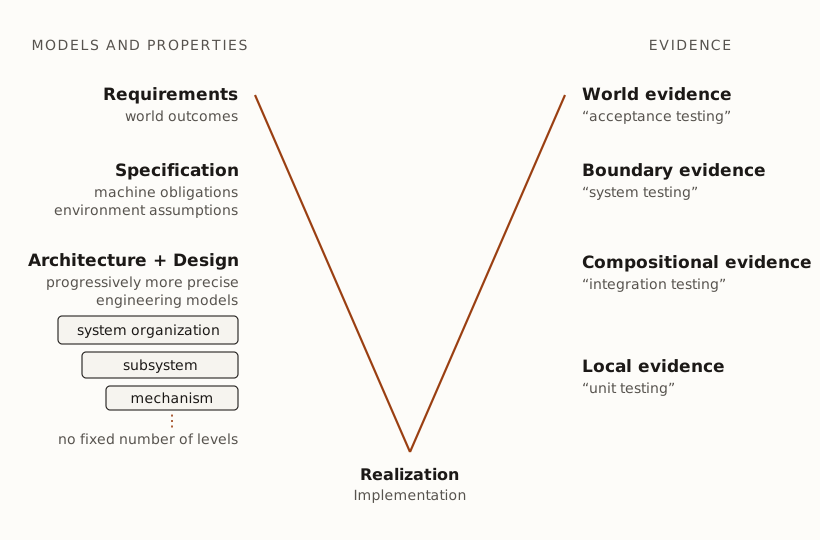
A conventional V-model is often drawn with a small number of development and testing levels. Figure 5 instead emphasizes the underlying engineering relationship: models introduce properties as the system becomes more precisely described, and validation asks what evidence bears on those properties at the scope where they live. The first question is therefore not whether a test is a unit, integration, or system test, but what property must be established, at what scope, and what evidence would justify believing it. The conventional labels are useful shorthand once those questions have been answered.
The figure also shows why “correctness” is not one property established once at the bottom of the V. Correctness may concern a local algorithm, the interaction of several components, behavior at a system boundary, or an outcome in the world. Quantitative properties behave similarly: memory consumption may belong primarily to one design, while end-to-end latency belongs to the path through which a request travels.
Validate a property at the scope where the property lives. Local evidence can contribute to a broader argument, but it cannot replace evidence about a property that exists only in composition. A unit test can establish something about one unit. It cannot by itself establish an end-to-end latency bound, system-wide consistency, or an outcome that depends on the environment.
Later chapters examine important classes of software properties more systematically. The point here is structural: engineering models make consequential properties explicit enough to guide realization, and validation asks what evidence establishes that the resulting system actually has them.
Evidence is always evidence for something, under assumptions. Those assumptions should be explicit because they bound what the evidence can mean. A proof can strongly establish a stated property relative to its model while saying nothing about a requirement omitted from that model. A load test establishes latency under the workload it generated, not under the workload users will generate. Treating “we have strong evidence” as a property of a system rather than of particular claims under particular assumptions is how validation programs mislead the people who rely on them.
The world, machine, and domain-assumption distinction from Specification matters again here. Most validation evidence attaches to the machine: tests, analyses, and proofs establish claims about behavior at the machine’s boundary. But requirements live in the world, and the connection to machine behavior runs through domain assumptions (Zave and Jackson 1997). A system can satisfy its specification perfectly while its requirement fails because a domain assumption was false. Machine-side evidence cannot expose that failure when the machine is behaving exactly as specified. Evidence from the world — observation of the deployed system in its actual environment — can. This is one reason operational evidence is part of validation rather than an afterthought.
Metrics connect properties to evidence
Earlier engineering activities use metrics to reason about properties before the complete realization exists: requirements attach measures to outcomes in the world, specification bounds latency or capacity at the machine boundary, architecture analyzes critical-path latency and failure domains, design compares mechanisms by memory or execution time. Validation uses these metrics to obtain evidence about whether the realized system has the properties those engineering decisions required.
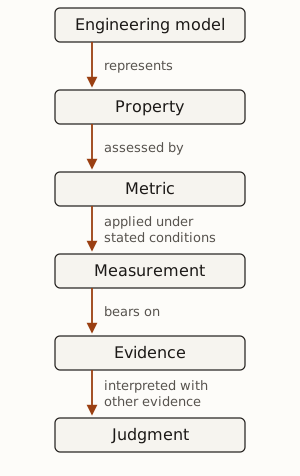
Three terms must remain distinct. A property is something about the system or its environment that matters to an engineering decision. A metric defines how some aspect of that property will be assessed. A measurement is a value obtained by applying the metric under particular conditions.
Suppose an architectural model predicts that a request path will remain below a 500 ms latency bound. Engineers might define the metric as p99 end-to-end request latency under workload W, then measure 420 ms in a validation experiment. The number is not meaningful evidence by itself. Its meaning comes from the property, the metric connecting the measurement to that property, and the workload and environment under which it was obtained (Figure 6).
A mismatch between model and measurement is itself engineering information. The implementation may be defective. The model may have omitted an important cost. Its assumptions may not describe the actual workload or environment. Or the metric may fail to capture the property engineers intended to assess. Validation does not assume that the model is right and ask only whether the implementation conforms to it.
Metrics therefore connect models to observations without replacing engineering judgment. Some important properties cannot be reduced to one useful number, and even quantitative evidence must be interpreted under assumptions. The engineering order runs from what matters to what should be measured: choose a metric because it can provide evidence about a consequential property, not because the number happens to be available.
Choose an evidence mechanism
| Decision | The question it asks |
|---|---|
| Claim | What do we need to believe? |
| Scope | Where does the property exist? |
| Mechanism | How can we obtain evidence? |
| Strategy | What should we explore, and how will failure be recognized? |
| Strength | How much does the resulting evidence justify? |
| Decision | Is the residual uncertainty acceptable? |
Claim and scope are the first two decisions a validation argument makes. The rest follow, and this chapter takes them in order (Table 2).
Once the claim and its scope are explicit, engineers can choose how to obtain evidence. Of each mechanism (Table 3), ask what uncertainty it can reduce, which failures it can expose or exclude, and what remains outside its reach.
| Mechanism | What it observes or reasons over | Characteristic strength | Characteristic limitation |
|---|---|---|---|
| Human review | An artifact, plus engineering reasoning about it | Semantic judgment: assumptions, unconsidered consequences, omitted concerns | Limited attention; only the cases a reviewer imagines |
| Dynamic testing | Selected executions of the realized system | Direct evidence of what the system actually does | Sampling: executions not performed remain unobserved |
| Static analysis and model checking | Possible behaviors, without producing each one | Excludes classes of failure, which no finite set of executions can | Holds only over the model or abstraction it analyzes |
| Measurement and experimentation | Quantities obtained under stated conditions | Quantitative evidence wherever a metric reaches the property | Depends on whether metric and conditions represent what matters |
| Operational observation | The deployed system in its actual environment | Real workloads, real users, real domain behavior | Evidence arrives after exposure to consequences has begun |
Scope and mechanism are independent choices. A component can be reviewed, tested, analyzed, or model-checked, and the same mechanism can be applied at a boundary or across an assembled system.
The first row carries a caution the others do not. Human judgment is what lets a reviewer notice that engineers solved the wrong problem, but attention is itself a limited validation mechanism. Research on vigilance shows that sustained monitoring requires substantial mental effort and imposes measurable workload and stress (Warm et al. 2008), while research on rare-target search shows that infrequent targets are disproportionately missed (Wolfe et al. 2005). These findings do not measure software review directly, but they matter increasingly as automated systems produce more artifacts for humans to supervise. A human reviewer should be used where human judgment is valuable, not treated as an infinitely scalable detector of rare defects.
Choosing dynamic testing still leaves another question: which executions should we seek, and how will we recognize failure?
Choose a validation strategy
Dynamic testing contains a second engineering choice. Generating executions is often cheaper than determining what each execution should produce. Validation strategies differ partly in how they solve this oracle problem: where the judgment that distinguishes acceptable from unacceptable behavior comes from (Table 4).
| Strategy | Oracle |
|---|---|
| Example-based | Expected result for a chosen input |
| Property-based | Property that generated executions must satisfy, possibly relating several executions |
| Differential | Agreement with an independent implementation |
| Fuzzing | Failure signal such as a crash, hang, or failed assertion |
Example-based testing requires an expected result for each test. This works well when important cases are known and their answers are easy to state. When they are not, a property can provide the oracle instead. For example, an engineer may not know the correct edge map for an arbitrary image, but may know that rotating the image before edge detection should have the same effect as rotating the resulting edge map. Properties that relate multiple executions in this way are often called metamorphic relations.
Other strategies obtain an oracle differently. Differential testing compares the results of independent implementations. Fuzzing often uses much weaker signals, such as crashes, hangs, or failed assertions. The choice depends on what failures must be found and what can be said about correct behavior.
The strategies are not ranked, and they combine. Fuzzing can drive a property-based oracle; differential comparison can supply the oracle for generated inputs. Strategy is also independent of scope: a property can be stated over a function, a service boundary, or an assembled system. Recognizing the shared problem matters more than memorizing the techniques, because new techniques will confront it too.
Judge the strength of the evidence
No technique supplies confidence by name alone. A model checker can exhaustively verify a property of the model while leaving an incorrect model untouched. Thousands of generated tests can explore an input space while sharing the same mistaken oracle. A code review can bring independent judgment while still missing behavior that neither reviewer considered. Evidence must be evaluated relative to the claim it supports and the assumptions on which it depends.
Evaluating a body of evidence is itself an engineering judgment, structured by several recurring dimensions (Table 5). None is a score; each names a question the evidence answers or leaves open.
| Dimension | The question it asks |
|---|---|
| Coverage | How much of the relevant behavior did the evidence examine? |
| Detection power | Would this evidence have exposed the failure we care about? |
| Representativeness | Do the examined conditions resemble the conditions of delivery? |
| Scope | Does the evidence attach where the property actually exists? |
| Independence | Could one mistaken assumption invalidate several pieces of evidence at once? |
| Assumptions | What must be true for this evidence to mean what we think it means? |
| Residual uncertainty | What consequential possibilities remain unresolved? |
Several have already appeared. Scope is the relationship expressed by the V-shaped picture: an argument that infers a compositional property from only local evidence has attached its evidence at the wrong scope. Assumptions include a technique’s own guarantees. When a tool claims soundness or completeness, engineers should know what its verdicts guarantee and over what model. Residual uncertainty is what the delivery decision ultimately weighs.
Detection power is the dimension most often confused with coverage. A test suite can execute every line of a module and assert almost nothing about what those lines produced. Mutation testing makes the difference visible: deliberately introduce small faults — invert a comparison, delete a statement, change a constant — and measure how many of them the suite detects. A high coverage figure beside a low mutation score describes evidence that reaches much of the system but notices little when it is wrong. The question is not whether the evidence reached the behavior, but whether it would have objected.
More observations can nevertheless provide more evidence. Suppose each test execution is represented by a bitmap recording which program lines it covered. Tests with different bitmaps can extend the portion of the implementation the suite has examined. Coverage of states, transitions, requirements, or other model elements can provide analogous information about what the evidence has reached. But coverage and detection power remain different questions. Exercising a line, state, or modeled obligation does not establish that the oracle would recognize incorrect behavior there.
Nor does diversity of coverage imply independence. Two tests can examine different behaviors while relying on the same mistaken oracle or assumption. Conversely, evidence obtained through different mechanisms can still share a model whose omission invalidates them together. Coverage asks where the evidence reached; detection power asks whether it would notice the failure; independence asks whether the same mistake could defeat several pieces of evidence at once. These dimensions must be judged separately.
These distinctions let us ask a deeper question: when should more observations make us more confident? Suppose five tests all pass, and then suppose 5,000 tests pass. It is tempting either to say that 5,000 must provide much stronger evidence, or to object that test count means nothing. Neither conclusion follows without a model connecting the observations to the claim. Conditional on a particular defect D existing, suppose each test independently has probability p = 0.01 of exposing and detecting it. The probability that n tests all miss the defect is then
P(all miss ∣ D) = (1−p)n.
For five tests, this probability is 0.995 ≈ 0.951. For 5,000 tests, it is 0.995000 ≈ 1.5 × 10⁻²². Under these assumptions, volume matters enormously: repeated observations genuinely accumulate evidence. This calculation is not the probability that the software is correct after n passing tests; that would require a model of how likely defects were beforehand. It tells us something narrower: if this particular defect exists and the stated detection model holds, how surprising is it that all n tests missed it?
But the calculation has compressed several engineering questions into p. The test-generation process must have some probability of exercising behavior that exposes the defect, and the oracle must recognize the defect when that behavior occurs. Schematically,
P(detect D) = P(exercise relevant behavior ∣ D) × P(recognize D ∣ exercised).
If generated tests cannot reach the defective behavior, the first probability is zero; millions of additional tests generated in the same way provide no evidence about that defect. For example, running the same input through a deterministic system 5,000 times does not explore 5,000 behaviors, nor does generating only positive inputs when the system has distinct behavior for positive and negative values. If every test shares an oracle that accepts the defective behavior, the second probability is zero. The calculation also assumes sufficiently independent opportunities for detection. If tests repeatedly exercise the same behavior, depend on the same mistaken assumption, or use the same systematically wrong oracle, multiplying the same miss probability n times is not justified.
This decomposition is schematic rather than a general formula for software reliability. Its purpose is to expose the assumptions compressed into the apparently simple claim that a test has a particular probability of detecting a defect. These are the dimensions just distinguished: where the evidence reaches, whether it can detect the failure there, and whether additional observations can fail for the same reason.
Cheap generation makes this distinction increasingly important. A tool can generate an implementation and 5,000 passing tests from the same interpretation of a requirement. Those tests may genuinely expand coverage while still sharing an oracle or assumption that systematically misses the behavior that matters. Conversely, a large body of tests generated under a defensible sampling and detection model can provide dramatically stronger evidence than a small one. As implementation and evidence production become cheaper, judging what the resulting artifacts actually establish becomes relatively more important. The engineering question is therefore not whether evidence volume matters, but what model justifies converting additional observations into additional confidence.
Confidence requires a model of the evidence
More observations can provide much stronger evidence, but their number alone does not determine how much stronger. Engineers must ask what additional observations exercise, what failures they can detect, and which assumptions they share.
Margin, discreteness, and containment
Other engineering disciplines provide useful concepts for reasoning about residual uncertainty. A tolerance describes a range of realized behavior that remains acceptable. A margin describes the separation between expected or observed behavior and an unacceptable boundary. Suppose, for example, that a system must keep p99 latency below 500 ms. Measurements of 420 ms and 499 ms both satisfy the requirement, but leave the engineer in very different positions. The first leaves substantially more room for variation in workload, environment, measurement, and prediction.
The observed separation from a threshold is not necessarily the margin an engineer can rely upon. Measurements vary, models omit effects, operating conditions change, and the conditions used for validation may differ from those encountered after delivery. Engineers therefore care about how much margin remains after accounting for the uncertainty relevant to the decision. A system barely inside a limit can satisfy its specification while providing little reason to believe that the limit will continue to hold as conditions vary.
Software complicates this reasoning because its behavior is discrete. Nearby inputs or states need not produce nearby outcomes. Changing one value, crossing one boundary condition, receiving one unexpected message, or taking one previously unexplored branch can move execution onto a qualitatively different path. Physical systems can also exhibit discontinuities such as fracture or instability, but discontinuity is routine in software. There is generally no useful notion that an execution was almost an authorization bypass or nearly performed the same transaction twice.
Discreteness limits what engineers can infer from observed executions. Executing many behaviors near an unexplored behavior does not generally establish what the unexplored behavior will do. Coverage tells us where evidence reached; it does not tell us how close we are to correctness. Statement, branch, condition, state-space, and requirements coverage can expose important gaps in a body of evidence, but increasing a coverage number does not by itself bound the behavior that remains unexplored.
Software architecture provides another response to residual uncertainty: constraining the consequences of behavior that validation fails to anticipate. This idea has deep roots in software modularity. Meyer distinguished modular continuity, in which a small change affects only a small number of modules, from modular protection, in which abnormal behavior remains confined to a small neighborhood of the system (Meyer 1997). The same principle matters for assurance. If engineers cannot economically establish everything a component might do, architectural controls can instead constrain what that component is permitted to affect.
The progression is worth stating plainly. Continuity bounds the propagation of change. Protection bounds the propagation of failure. Containment bounds the consequences of what the evidence failed to discover. Meyer offered locality as a criterion of good modular structure; validation asks how that same structure changes the evidence required to act under uncertainty.
The controls are familiar, but validation gives them a second job. Interfaces constrain how components can interact. Process and container isolation can prevent one failure from corrupting unrelated components. Type and memory-safety mechanisms exclude classes of behavior. Permissions constrain authority. Transactions constrain partially completed changes. Resource limits, timeouts, and circuit breakers restrict propagation. Staged rollout limits the population exposed to a new behavior, while rollback can shorten the time for which a discovered failure remains active. Architecture treated a boundary as a decision about what must be reasoned about together and what can fail independently. Here, the same boundary can convert an open-ended validation problem into a bounded consequence problem.
These controls do not establish that the software inside them is correct. They change the consequence of being wrong. If an uncertain component has unrestricted authority over a consequential system, uncertainty about its behavior may demand very strong evidence before delivery. If the same uncertainty is enclosed by controls that make consequential outcomes impossible or tightly bounded, the delivery decision can be different. Architecture therefore contributes to validation not only by making systems easier to test, but by bounding what failures that validation missed can affect.
These two kinds of residual uncertainty therefore admit different responses (Table 6).
| Kind of residual uncertainty | What the evidence can establish | The engineering response |
|---|---|---|
| Quantitative — a measured property standing some distance from a threshold | A separation that can be estimated, compared, and degraded by known sources of variation | Margin: how much separation survives the variation that matters |
| Discrete — an unexplored behavior or an unanticipated state | Where evidence reached, but no distance from failure | Containment: how far a failure is permitted to propagate if it occurs |
Engineers therefore have several distinct ways to reason about uncertainty. Margin asks how far observed behavior is from a known unacceptable boundary. Coverage asks where evidence has reached. Containment asks what can happen where the evidence is wrong. Reversibility asks what engineers can do after discovering they were wrong. None eliminates uncertainty. Together they help determine whether the remaining uncertainty is acceptable for the consequences of the decision.
Deciding when to stop
No practical amount of validation establishes every relevant property over every possible software behavior. The delivery decision therefore concerns residual uncertainty: what remains unknown, and what follows if the evidence is wrong.
Additional evidence has a cost: the effort to produce it, the attention required to evaluate it, and the value delayed while obtaining it. Process observed that delivering an increment can itself generate information. Withholding delivery to obtain more evidence therefore also has a price, and the earlier mismatch table applies directly. For a low-consequence system, delivering with unresolved uncertainty can be defensible, while demanding near-certainty can become overengineering: consuming resources without commensurate value. For a high-consequence system, the same unresolved uncertainty may justify expensive and diverse evidence, or it may mean that delivery cannot currently be defended at all.
Before delivering, engineers can work through a short sequence of questions drawn from the argument above.
- Claims. Have we obtained evidence for the consequential claims, rather than for whichever claims happened to be convenient to examine?
- Strength. How strong is that evidence along the dimensions above — its coverage, detection power, representativeness, scope, independence, and assumptions?
- Margin. Where the behavior is quantitative, how much defensible separation remains before the behavior becomes unacceptable?
- Containment. If an unanticipated behavior occurs, what controls limit its consequences?
- Consequence. What happens in the world if these arguments are wrong?
- Reversibility. Can we detect, stop, repair, and recover from a failure discovered after delivery?
These questions do not compute a decision. They make the judgment answerable. An engineer who can say what the evidence establishes, how far the system sits from unacceptable behavior, what bounds a failure, and what can be done afterward has provided reasons another engineer can examine. That is what separates professional judgment from preference.
The decision at the end of validation is not binary. Evidence that fails to justify delivery does not merely say “stop”; it usually indicates where the problem lies, and the response should go there.
The delivery decision
Deliver when the evidence supports the claims that matter at a standard defensible for the consequences. Gather more evidence when the shortfall is knowledge and additional evidence is worth its cost. Change the system when the evidence exposes behavior that should not be delivered. Revisit an upstream decision when the evidence indicts a requirement, specification, architecture, or design rather than the implementation. Refuse when the consequences demand a standard the available evidence cannot meet and no party can make that gap disappear by accepting it.
The last option needs no new argument. It is the professional authority of this chapter’s opening applied at the moment it matters. The three inputs remain distinct: consequence establishes what is at stake; stakeholders judge which outcomes, costs, and risks they will accept; the engineer judges what the evidence allows them to stand behind. A delivery decision is defensible when it can answer to all three. People can agree about what a failure would do and still disagree about what evidence its possibility demands.
Measurement for decision-making
Measurement has appeared in every chapter of this handbook, because an engineering model makes claims that observation can test. Validation is where the chain acquires its last links:
Property → Metric → Measurement → Evidence → Judgment
The earlier chapters could supply the first three. A requirement names an outcome and asks what would show that it was achieved. A specification tells engineers which distinction to watch for. An architecture predicts a property of the composition. A design measures a mechanism under a workload. What none of those activities settles on its own is the standard the resulting observation must meet, and that standard is what this chapter has developed. Whether the evidence attaches at the scope where the property exists (“Validate at the scope of the property”), whether it would have objected had the system been wrong (Table 5), how much separation remains before behavior becomes unacceptable (“Margin, discreteness, and containment”), and how much evidence the consequence of being wrong demands (“Consequence changes the amount of evidence we should demand”): these ask what a measurement is worth, not how to obtain it.
The question validation puts to any measurement is therefore not whether the number is accurate. It is whether the evidence is strong enough for the consequence of being wrong. Two teams can obtain the same measurement under the same conditions and still owe different amounts of further work, because what happens to the world if they have misread it differs.
That judgment is provisional in one further respect. Later evidence can overturn it. When reality contradicts a claim the evidence appeared to support, engineers can reconstruct what they believed, which evidence justified the belief, and which part of the engineering model should now change: the requirement, the specification, the architecture, the design, or the metric that reported the property. Failure-Aware Engineering develops that reconstruction. The next section begins it, because evidence of that kind first arrives in operation.
Evidence after delivery
Delivery moves the system into the one environment no earlier validation could fully reproduce, and the environment repays the favor with evidence. Monitoring reveals behavior under real workloads. Incidents expose failures no one selected as a test case. Field measurements and experiments quantify what analysis could only estimate. User reports carry consequences engineers did not predict. The world itself also changes: a domain assumption that was true at delivery can quietly become false as usage, populations, and conditions shift. Operational observation is therefore not a courtesy that follows validation. It is validation continuing under better evidence.
Evidence also ages when the system changes. A modification need not invalidate all previous evidence, but engineers must ask which claims the change could affect and which evidence must therefore be renewed. Regression testing is one common mechanism for doing so.
The crucial point is that the decision must update when the evidence does. It is one thing to deliver amid uncertainty about possible harm; that uncertainty was weighed, and the decision may have been sound. It is another to continue the same behavior after evidence of substantial harm accumulates. The original justification cannot be reused, because it was a justification under a state of knowledge that no longer exists.
Recent litigation against social-media companies illustrates the distinction. Plaintiffs, including states and school districts, have alleged that platform design features harmed young users and that companies continued delivering those features after internal evidence of harm accumulated. Of course, the court system is not engineering, and legal allegations do not establish engineering conclusions. But the engineering lesson does not depend on the outcome of these cases. The shape of the accusation is exactly the failure this section names: not that you delivered under uncertainty, but that your evidence changed and your decision did not.
Software’s medium gives this duty particular force. Software Engineering observed that copyability and updateability cut both ways: the mechanism that propagates a repair across millions of instances can propagate a defect across them too. Updateability makes learning after delivery a legitimate strategy when failures are tolerable: a repair can reach everyone cheaply. It also makes inaction harder to defend when failures are not tolerable. Once evidence shows that deployed behavior should change, engineers can often change it everywhere, quickly. An engineer who could respond and does not has still made a decision, one that must be justified under the new state of knowledge.
Summary
Validation asks what evidence is sufficient to deliver a software system into the world. The question is broader than testing and does not demand certainty. Software’s updateability can make delivery under known uncertainty a legitimate way to learn, but only when discovering a failure after delivery is acceptable: an update can repair the software, not the consequences of its previous behavior.
Three inputs shape the standard applied at delivery, and none substitutes for the others. Consequences establish what is at stake. Stakeholders judge which outcomes, costs, and risks they will accept. Engineers independently judge what the available evidence allows them to stand behind. That judgment can fail in either direction, by demanding more assurance than minor consequences warrant or less than substantial ones require.
Evidence starts from properties and claims, not techniques. Engineering models make consequential properties explicit at different scopes as decisions move toward realization; validation works back through those scopes. Evidence must attach where the property exists: local evidence cannot by itself establish a property that exists only in composition.
Metrics connect properties to observations: a property identifies what matters, a metric defines how an aspect of it will be assessed, and a measurement supplies an observed value under stated conditions. Measurements become evidence only relative to claims and assumptions. Engineers choose sources of evidence according to the uncertainty each can reduce, then judge the resulting body of evidence by its coverage, detection power, representativeness, scope, independence, assumptions, and residual uncertainty. Additional observations can greatly strengthen evidence, but only when a defensible model explains how those observations bear on the claim and how their opportunities for detection accumulate.
Software’s discreteness bounds what this evidence can establish. Nearby inputs and states need not produce nearby behavior, so coverage identifies where evidence reached rather than how near the system is to correctness. Margin helps reason about quantitative uncertainty; containment bounds the consequences of discrete behavior that evidence missed; reversibility determines what engineers can do after discovering they were wrong.
The resulting decision is not binary: deliver, gather more evidence, change the system, revisit an upstream decision, or refuse. The judgment recurs after delivery because evidence keeps arriving, the system and world keep changing, and a justification made under one state of knowledge cannot simply be reused under another.
Read Further
Winters, Titus, Tom Manshreck, and Hyrum Wright. Software Engineering at Google: Lessons Learned from Programming over Time. O’Reilly Media, 2020, chaps. 9 and 11–14. An account of how engineers obtain evidence at different scopes, from review through unit tests to larger-scale testing. Read the “Code Review” chapter and the testing chapters.
Cockx, Jesper. “An Introduction to Property-Based Testing with Quickcheck.” 2020. https://jesper.sikanda.be/posts/quickcheck-intro.html. Introduces property-based testing: state properties that should hold across a class of inputs, then generate inputs in search of counterexamples. The Haskell syntax is incidental; the validation strategy is not. For the technique’s origin: Claessen, Koen, and John Hughes. “Quickcheck: A Lightweight Tool for Random Testing of Haskell Programs.” In Proceedings of the Fifth ACM SIGPLAN International Conference on Functional Programming (ICFP 2000). ACM, 2000. For a contemporary application in an agentic setting: Anthropic. “Finding Bugs across the Python Ecosystem with Claude and Property-Based Testing.” Anthropic, 2026. https://www.anthropic.com/research/property-based-testing.
Warm, Joel S., Raja Parasuraman, and Gerald Matthews. “Vigilance Requires Hard Mental Work and Is Stressful.” Human Factors 50, no. 3 (2008): 433–41. https://doi.org/10.1518/001872008X312152. Why sustained monitoring is demanding work rather than the passive activity it appears to be, and so why assurance does not scale by putting more machine output in front of human reviewers.
McKeeman, William M. “Differential Testing for Software.” Digital Technical Journal 10, no. 1 (1998): 100–107. Introduces differential testing: independently developed implementations serve as partial oracles for one another.
Miller, Barton P., Mengxiao Zhang, and Elisa R. Heymann. “The Relevance of Classic Fuzz Testing: Have We Solved This One?.” IEEE Transactions on Software Engineering 48, no. 6 (2022): 2028–39. https://doi.org/10.1109/TSE.2020.3047766. Repeats the original fuzz-testing experiment decades later on widely used utilities and still finds failures, showing how much evidence cheap input generation and a weak oracle obtain on their own.
Palshikar, Girish Keshav. “An Introduction to Model Checking.” Embedded Systems Programming, 2004. An accessible introduction to model checking and the evidence obtained by exhaustively checking a model.