
Model-Based Agentic Software Engineering
How should we engineer software when implementation becomes abundant but engineering judgment remains scarce?
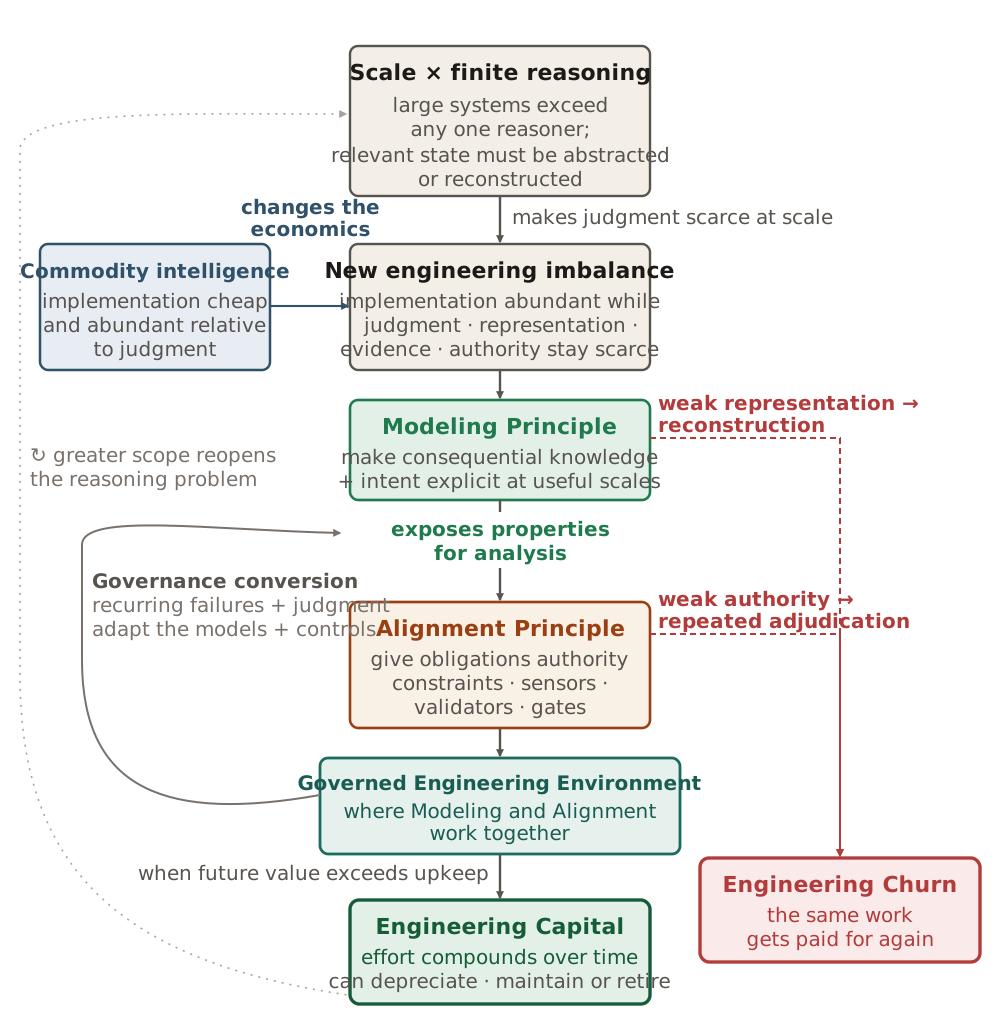
Capable agents have made it much cheaper to produce working code. They have not made it cheaper to decide what should be built, which obligations govern it, how to read the resulting evidence, or whether the system is acceptable to ship.
MAGE studies the engineering structures that make delegated implementation governable: making consequential knowledge explicit as models, giving selected obligations authority over what agents produce, validating realizations against those models, and turning recurring human judgment into structures that later work can reuse.
The engineering problem
Capable agents have made producing working code much cheaper. They have not made it cheaper to decide what should be built, which obligations govern it, or whether the result is acceptable.
- Model-Based Agentic Software Engineering (The MAGE Book)
Under contract with MIT Press, expected · 2027
The book-length statement of the framework. - Model-Based Agentic Software Engineering
JAWs · 2026
An 8-page condensed statement of the MAGE theory. - Software Supply Chains are Dead: Use-Case-Oriented Regeneration
ESEM-ERVR · 2026
Explores how cheap regeneration changes the economics of reuse, connecting earlier software-supply-chain research to the agentic setting.
Systems and studies behind MAGE
MAGE did not begin as an abstract framework. It grew partly from building and studying agentic software systems and confronting the engineering problems that appeared when implementation became cheap. The projects below supplied worked examples, empirical evidence, and recurring problems that informed the framework; several also illustrate principles that MAGE later makes explicit.
- Cheap Code, Costly Judgment: A Case Study on Governable Agentic Software Engineering
2026
The most direct worked case behind MAGE: a study of what happens when agent-produced implementation becomes cheap while specification, validation, exception handling, and engineering judgment remain scarce. - SAGE: Structured Agentic Graph Editing for Software Diagrams
2026
A worked example of the Modeling Principle: agents manipulate an explicit graph representation of a software diagram rather than treating the diagram as an opaque picture. - SysLLMatic: Large Language Models are Software System Optimizers
arXiv · 2025
A worked agentic system for optimizing real software, and an early demonstration of how capable models can cheaply search implementation alternatives while measurement remains external to the agent. - How Do Agents Perform Code Optimization? An Empirical Study
International Mining Software Repositories Confe · 2026
Studies how agents actually perform optimization, including the strategies and limitations that appear when they work against real software. - Beyond Local Code Optimization: Multi-Agent Reasoning for Software System Optimization
JAWs · 2026
Extends agentic optimization beyond isolated edits to system-level reasoning, where representation, coordination, and validation become increasingly consequential. - AgentHub: A Registry for Discoverable, Verifiable, and Reproducible AI Agents
JAWs · 2026
Explores another recurring MAGE concern at ecosystem scale: making consequential properties explicit enough that agent artifacts can be discovered, verified, and reproduced.
Implications beyond conventional engineering
MAGE’s implications extend beyond the engineering team. Institutions that acquire software face the same changing economics: producing a capability has become cheaper, while deciding what to acquire, which obligations govern it, and what evidence justifies acceptance has not. We are beginning to study what this shift means for organisations that acquire and field software rather than build it themselves.
- Is US Defense Acquisition Ready to Acquire AI-Enabled Capabilities? Assessing the DoD Software Acquisition Pathway Through a Scenario-Based Policy Analysis
2026
Asks what the DoD software acquisition pathway assumes about how software is produced, through a scenario-based policy analysis.
Funding and support
This work has been supported by:
- US National Science Foundation — CAREER: PTM-SEER: Software Engineering Foundations for Re-Using Pre-Trained Neural Models (#2541917)
- US National Science Foundation — RFE: Research: Developing and Piloting a Prompt Engineering Competency Framework for Software Engineering Education (#2452533)