
Software Supply Chains
How can software reuse remain trustworthy at ecosystem scale?
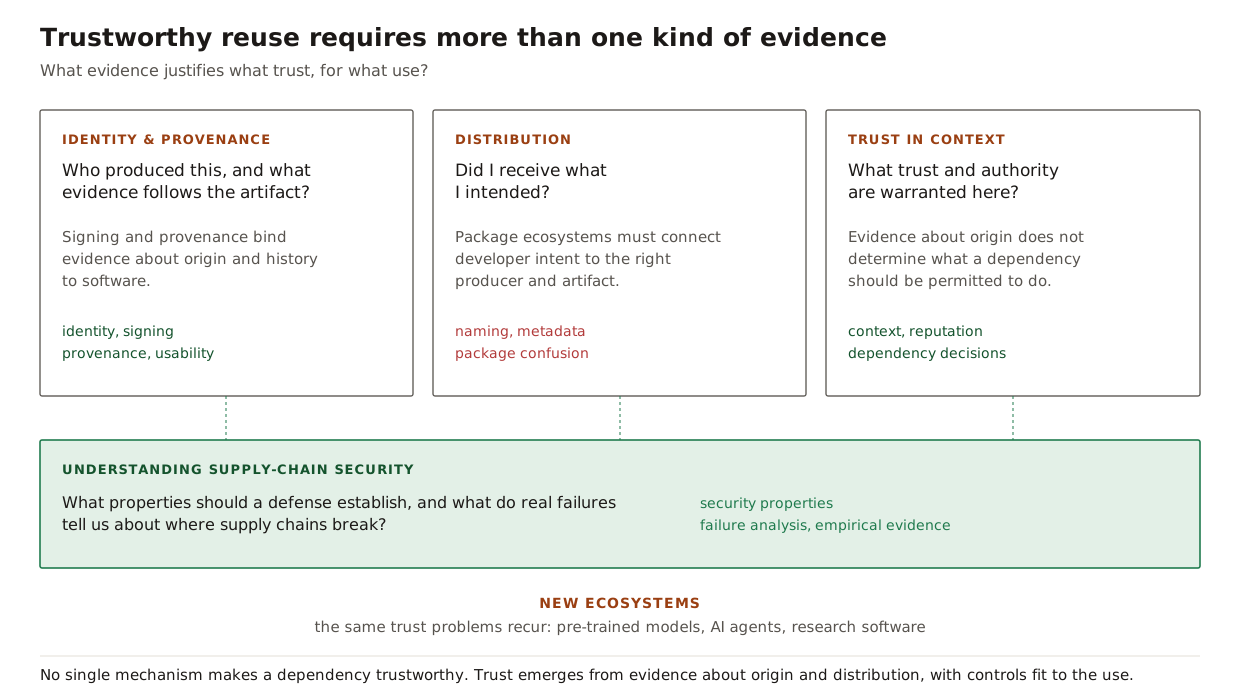
Modern software systems depend on artifacts produced by people and organizations their developers may never meet. Package registries and build systems make reuse inexpensive, but they separate the act of using software from direct knowledge of who produced it, how it reached the consumer, and what authority it should receive once incorporated into a system.
We study the evidence and engineering mechanisms that make trust possible across those boundaries: establishing identity and provenance, protecting the distribution process, and making trust decisions sensitive to the context in which a dependency is actually used. Across these problems, the recurring question is not simply whether software is trusted, but what evidence justifies what trust, for what use.
Understanding software supply-chain security
Before defending a software supply chain, we need to know what a defense is supposed to establish, and where real supply chains actually fail. This cross-cutting work develops models for reasoning about supply-chain security and methods for extracting evidence from failures at ecosystem scale.
- SoK: Analysis of Software Supply Chain Security by Establishing Secure Design Properties
SCORED · 2022
Systematized the field around three properties — transparency, validity, separation — giving later work a vocabulary for what a defence establishes. - An Empirical Study on Using Large Language Models to Analyze Software Supply Chain Security Failures
SCORED · 2023
Tests whether language models can analyze supply-chain failures at the scale the evidence actually exists. - Reproducibility is Not Enough: Artifact Verifiability in Decentralized-Build Package Ecosystems
2026
Asks whether a reproducible build is enough to establish that the artifact you received is the one that was built.
Establishing identity and provenance
Software signing can bind an artifact to evidence about its producer and history — but only if the mechanism is adopted, usable, and interpreted correctly. We study what signing and identity establish in practice, why organizations adopt them, and what prevents these mechanisms from becoming routine parts of software development.
- Signing in Four Public Software Package Registries: Quantity, Quality, and Influencing Factors
S&P · 2024
Measured signing across four public registries. Established how rare and how poor-quality signing actually was, against which later adoption work reads. - An Industry Interview Study of Software Signing for Supply Chain Security
SECURITY · 2025
Interviewed industry practitioners about signing. Found that the obstacles are organizational as often as technical. - Why Johnny Adopts Identity-Based Software Signing: A Usability Case Study of Sigstore
SECURITY · 2026
A usability study of Sigstore adoption. Identity-based signing removes the key-management problem and introduces others. - Identity-Based Signing Shifts, Not Solves, Usability: Evidence from Five Identity-Based Signing Ecosystems
arXiv · 2026
Follows identity-based signing usability over time rather than at one moment, which is where adoption problems become visible. - Establishing Provenance Before Coding: Traditional and Next-Gen Software Signing
IEEE Security & Privacy Magazine -- Special Issu · 2025
States the provenance-before-coding argument for a practitioner audience.
Protecting the distribution boundary
Even trustworthy producers and valid artifacts can be defeated by ambiguity in distribution. Package ecosystems use names and metadata to connect developer intent to producers and artifacts; attackers exploit that mapping through typosquatting and package-confusion attacks. We study how those ambiguities can be detected before the wrong dependency enters a system.
- ConfuGuard: Using Metadata to Detect Active and Stealthy Package Confusion Attacks Accurately and at Scale
ICSE · 2026
ConfuGuard detects package confusion from metadata, treating a familiar package name as evidence that can be forged.
Making trust contextual
Provenance is evidence, not a verdict. A valid signature does not establish that its producer is trustworthy, that a dependency is appropriate for a particular system, or that it should receive all of the authority available to its caller. We study how trust decisions can incorporate the context in which software is actually used — and how systems can limit the consequences when that trust is misplaced.
- Context-Aware Trust Verification for Identity-Based Software Signing
ASE · 2026
Verification that accounts for context: what a signature means depends on what is being installed where. - Towards a Benchmark for Dependency Decision-Making
JAWs · 2026
Dependency decision-making has no benchmark, so competing approaches cannot be compared. This proposes one. - ARMS: A Vision for Actor Reputation Metric Systems in the Open-Source Software Supply Chain
JAWs · 2026
Maintainers can review a pull request for correctness but not for the trustworthiness of its author; ARMS proposes reputation as the missing signal. - ZTD-JAVA: Mitigating Software Supply Chain Vulnerabilities via Zero-Trust Dependencies
ICSE · 2025
ZTD-JAVA moves the trust decision to the point of use: a library gets the permissions its call site needs, not those of the whole application.
The same trust problems in newer ecosystems
New ecosystems often acquire mechanisms for distributing reusable artifacts before they acquire mature mechanisms for trusting them. Pre-trained models, AI agents, and research software change what is distributed and how it is consumed, but inherit familiar problems of provenance, distribution, authority, and ecosystem governance.
- PickleBall: Secure Deserialization of Pickle-based Machine Learning Models best artifact
CCS · 2025
A model file that executes code when loaded is an attack surface, and model repositories distribute those files the way registries distribute packages. - AgentHub: A Registry for Discoverable, Verifiable, and Reproducible AI Agents
JAWs · 2026
Agent ecosystems are beginning to distribute executable capability, and they inherit the registry trust problem before they inherit its defences. - Operationalizing Research Software for Supply Chain Security
JAWs · 2026
Research software has a supply chain with different incentives and far less tooling than industry's. - AgOSS: A Dataset and Multi-Layer Characterization of Open-Source Agricultural Software
2026
A dataset and multi-layer characterization of open-source software in a domain the field rarely examines.
Funding and support
This work has been supported by:
- US National Science Foundation — Collaborative Research: Planning: CROSS: Building a Community aROund Securing the Research Software Supply Chain (#2537308)
- Socket, Inc. — Unrestricted Gift: Typosquat Detection in Open-Source Ecosystems
- Google, LLC — Unrestricted Gift: Improving OSS Supply Chain Security by Promoting Software Signing
- US National Science Foundation — POSE: Phase I: Scoping An Open-Source Ecosystem Around Proactive Software Supply Chain Monitoring (#2229703)
- Cisco — Monitor and manage security risks in software supply chains with Sigstore