Technical Debt in Agentic Software Engineering
Premise. A working implementation is not necessarily one we understand, one whose reasons anyone recorded, or one we can safely change. The central problem is not simply that working software may contain debt. It is that implementation can precede engineering understanding.
We vibed an implementation, and it works. A coding agent took the specification and returned an application that deploys, passes its tests, and answers at its API. That specification fixed what the machine must do at its boundary with the world; it said little about how the machine is organized inside, and the agent chose that. So a green suite is evidence about the behavior we checked, not about the structure we received. What the next consequential change will cost, and whether it can be made safely, stays invisible until someone must make it.
Three different things can have deteriorated behind such a system, and only one of them is in the code: the structure, the team's shared understanding of how it works, and the recorded rationale a later engineer or a later agent would need. This unit separates the three, then recovers the models and collects the evidence each one needs.
Structure of this unit
Lecture: Technical Debt in Agentic Software Engineering. Understanding, architecture, and dependencies. A single lecture in three parts. Technical debt, architecture, and dependency risk are longstanding engineering problems; coding agents change their economics and the circumstances under which they arise, not their nature. Throughout, we ask what models and evidence support a decision to retain, restructure, update, or replace part of a working system.
Part I: Cognitive and intent debt. What do we understand about the software we obtained? We adopt Storey's Triple Debt Model, separate deteriorating understanding from unrecorded rationale, show that both survive a green test suite, and close by recovering an architecture — the first evidence in the unit that is not a passing test.
Part II: Architectural technical debt. Can we afford the structure the agent chose? We define architectural technical debt, price a structural compromise before examining any pattern, then work through weak boundaries and erosion, change-impact analysis, the modular monolith against separately deployed services, and what must stay true during a restructuring.
Part III: Dependency management and technical debt. What did we agree to maintain and trust? We rule on one package the agent proposed: distinguishing maintenance risk, security exposure, and distribution obligation from debt proper, then using dependency graphs, SBOMs, licenses, provenance, and vulnerability evidence to decide whether to retain, update, isolate, replace, or remove it.
Three forms of debt
Margaret-Anne Storey's Triple Debt Model names the three and says where each one lives. The distinction is the useful part: these are not three words for one kind of badness.
| Debt | Where it resides | What has deteriorated |
|---|---|---|
| Technical debt | The software | Structure and implementation choices that increase future engineering costs |
| Cognitive debt | The people who build it | Shared understanding of how the system works and how it can be changed |
| Intent debt | Externalized knowledge | Recorded goals, constraints, and rationale needed to understand and evolve the system |
Each can occur without the others. A system can have a clean architecture and substantial cognitive debt: the structure is sound, everyone who built it is still on the team, and still nobody can predict what a change will break. A system can be thoroughly documented and still carry heavy technical debt, because writing a compromise down does not make it cheap. And a team can understand a system perfectly while having recorded none of it, which is intent debt with no cognitive debt at all — until somebody leaves.
Storey's own example is a student team that built software rapidly with AI. By week eight simple changes had become unexpectedly difficult, and the team first blamed messy code. The investigation found something else: no one could explain why particular design decisions had been made, or how the parts were supposed to work together. The features still shipped and the tests still passed. A grey-literature study of 76 practitioner sources reports the same shape, with cognitive debt accumulating behind working software and passing tests, particularly where AI-generated changes are accepted without the reviewer developing enough understanding to predict their consequences.
The three debts call for three kinds of work, and the repairs do not substitute for one another.
| Debt | What would show it | What repairs it |
|---|---|---|
| Cognitive | Can engineers explain the structure and predict what a change touches? | Guided investigation, review that teaches, deliberate knowledge sharing |
| Intent | Are the consequential constraints and decisions recorded anywhere? | Models, decision records, specifications |
| Technical | Do structural compromises make the changes we expect more expensive? | Refactoring, restructuring, replacement |
Refactoring changes the code and leaves the team's understanding where it was, or worse, because the structure they half-understood has moved. Documentation records a decision and corrects no architecture. This is where models earn their place and also where the overclaim lies: a model of an obligation or a recorded decision is exactly the externalized knowledge intent debt is missing, so writing the architecture down reduces intent debt. It does not by itself reduce cognitive debt. A model being available does not establish that any engineer understands it. An accurate, current page nobody consults is not shared understanding.
Buying back the understanding
There is a diagnostic asymmetry here, and it explains why cognitive debt goes unmanaged. Cognitive debt is the one that cannot be established from artifacts alone: a tool can read structure, and it can at least report whether a decision record exists and what it covers, so technical and intent debt each leave a partial trace. Understanding leaves none, so the only probe is to ask the engineers. The repair for what the artifacts do not show is investigation, and architecture recovery is the concrete form it takes: it produces understanding where there was none, and it produces an artifact that records what was found.
Consider the campus reservation service of the preceding units, which now has an execution environment, persistent storage, and a means of deploying updates. The university introduces laboratory reservations, needing different booking policies and approval procedures. The application still works, but implementing the new requirement may reveal that reservation rules are scattered across HTTP handlers, database queries, and authorization checks.
An engineer examining an unfamiliar implementation can construct a dependency model showing which components use which others. The recovered model is an abstraction, constructed to answer a particular engineering question rather than to describe every implementation detail. Recovery becomes informative when that model is set against the structure the architecture intended.
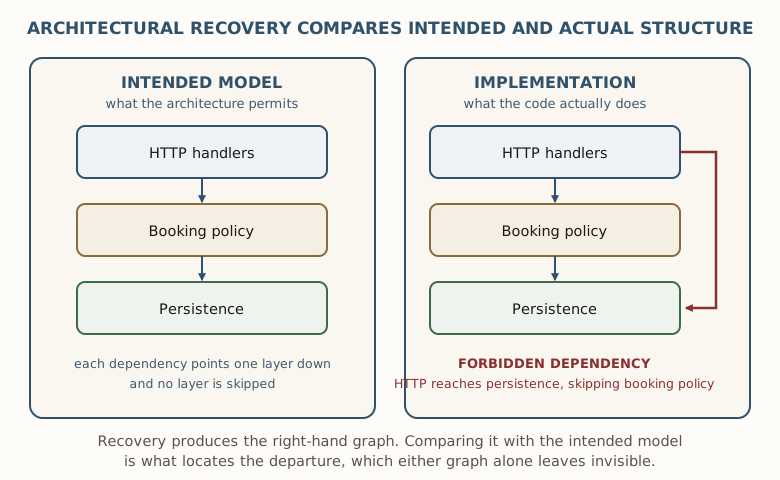
Recovery answers what the structure is. It says nothing about what keeping it will cost, and the recovered model records no reasons: nobody has told us why the structure is like this, so the intent is still missing even once the understanding is bought.
Architectural technical debt
The established term for the cost side is architectural technical debt (ATD): technical debt incurred in consequential architectural decisions — how the system is decomposed, what its interfaces are, which frameworks and technologies it rests on — choices that later become constraints on how the system can evolve. Verdecchia, Kruchten, Lago, and Malavolta develop the definition from interviews with software architects; Kruchten, Nord, and Ozkaya's Managing Technical Debt, written at Carnegie Mellon's Software Engineering Institute, is the practitioner treatment.
Three phrases carry the definition. Consequential narrows it to decisions that are expensive to revisit. Decisions locates the debt in a choice that could have gone otherwise, not in a file somebody dislikes. And become constraints is the mechanism: a decomposition chosen in week two is a constraint by year two, and the cost arrives when evolution meets it.
Pricing a structural compromise
Technical debt describes an economic consequence of a decision: the expected additional cost of future work attributable to a design or implementation compromise. It is not a verdict on how the code looks. A Big Ball of Mud built deliberately as a throwaway prototype may impose no cost on any work we intend to do, and a well-structured system can carry substantial debt from a slower algorithm chosen to meet a deadline, from postponed test automation, or from a library whose migration path is expensive. Undesirable structure and technical debt are two judgments, and the engineer's responsibility is to keep them separate.
The definition is narrower than "any earlier choice that imposes future cost." Ordinary maintenance imposes future cost, and so does a sound tradeoff whose consequences were unavoidable; what makes a cost debt is the comparison with a plausible alternative available at the time. Fowler separates deliberate compromises from inadvertent ones and prudent decisions from reckless ones, which is why debt can be a defensible choice rather than evidence of poor engineering.
Deciding whether to repay is a comparison over a horizon. Leaving the compromise in place costs something each time the system changes within that horizon. Correcting it costs an immediate investment plus the risk of the restructuring itself. Repayment is justified when the recurring cost over the expected lifetime exceeds that investment. Both sides depend on changes nobody has made yet, so this is a decision model rather than a measurement.
A worked comparison makes the horizon concrete. Say the clean design costs ten staff-days, and the shortcut two now, half a staff-day per month in place, and twelve to retrofit. Retire at three months: 2 + (0.5 × 3) = 3.5 against ten, and the shortcut was right. Retrofit at twelve: 2 + (0.5 × 12) + 12 = 20 against the same ten, and the clean design was cheaper all along. One decision, two verdicts, separated only by the horizon. Every figure is assumed.
Weak boundaries and erosion
Two structural conditions are routinely mistaken for this debt, and both describe shape rather than cost. A Big Ball of Mud is an implementation with few stable or comprehensible boundaries; Foote and Yoder describe how repeated local changes under schedule pressure produce one without anyone deciding on it. Architectural erosion is a relationship rather than a structure: the implementation increasingly violates boundaries an intended architecture established. A system can exhibit one without the other. Code written without a design cannot erode from it.
| Condition | What we observe | Model required | Engineering question |
|---|---|---|---|
| Big Ball of Mud | Weak or indiscernible boundaries | Recovered architecture | Is the structure adequate for the expected changes? |
| Architectural erosion | Divergence from intended boundaries | Intended and recovered architectures | Should we restore the intended boundaries or revise them? |
Neither condition is a verdict on the engineering. Each is a possible symptom of architectural technical debt, an observation the economic judgment above then acts on.
A recovered model can also reveal cycles, heavily depended-upon components, and dependencies that cross intended boundaries. Other useful evidence includes fan-in and fan-out, the number of components affected by a representative change, and change coupling: components that repeatedly change together even when their static dependencies do not explain why. All of it requires interpretation. A component with many dependents may be a useful stable abstraction rather than a defect, and two modules that change together may be one badly divided responsibility or simply one recurring feature. No single coupling score establishes maintainability.
The useful question is more specific. If the reservation policy changes, which parts of the system must change with it? A dependency graph predicts an answer; an implementation probe or an examination of actual changes supplies evidence. When the model says booking policy is isolated and the change also touches HTTP handling and persistence, the model has failed to represent the coupling.
Architectural patterns as engineering choices
Architectural patterns describe recurring ways to organize software, together with expectations about their consequences; Act I introduced layering, pipelines, repositories, event-driven communication, and ports and adapters. The patterns that organize whole applications differ mainly in where they place their boundaries: a monolith ships one deployable unit, a modular monolith keeps one deployment while establishing explicit internal boundaries, and a microservice architecture distributes responsibilities among independently deployable services. The reservation service can expose the same HTTP API under any of them, so the pattern name settles nothing.
These alternatives trade different kinds of coupling. A modular monolith can isolate booking policy behind an interface while retaining local calls and transactions. Extracting booking into a separate service may permit independent deployment and scaling, at the price of network latency, partial failure, interface compatibility, and decisions about data ownership. Moving a boundary from inside a process to a network interface does not automatically make the system easier to change.
The semester's reservation service shows what the last of those costs. A reservation is confirmed only when the booking and its approval are both valid, and while both live in one deployable that rule is enforced inside a single transaction. Split booking from approval and each service owns part of the state the rule ranges over, so the single enforcement point is gone. Something must replace it: a coordinating protocol, a compensating action, or an accepted window of disagreement. That coordination obligation, not the latency, is the substantial price of the boundary — and a monolith is one deployable, not necessarily one unstructured system.
For a small reservation application the modular monolith may be the better choice; where separate teams must deploy and operate booking capabilities independently, service decomposition becomes more attractive. The decision follows from the expected changes and the operational requirements, not from a preference for smaller services.
Restructuring under control
Restructuring is a controlled process, not a rewrite. Refactoring changes the internal structure of software while preserving its externally observable behavior. Unfamiliar code may first need characterization tests that establish what the existing implementation actually does, and a consequential migration may require old and new implementations to coexist while functionality moves incrementally, as in the strangler pattern. The order of work is what keeps the change controlled:
- Recover the current structure and behavior.
- Identify the boundary to change.
- Establish characterization and invariant tests.
- Restructure incrementally.
- Verify that obligations remain satisfied.
Coding agents change this calculation because implementation and assurance costs need not decline together. Generating an alternative structure may become inexpensive. Establishing that it preserves the system's obligations can remain costly, because its behavior, its interfaces, and the properties its tests and controls pin must all survive the change. Cheaper implementation moves one term in the comparison and leaves the other where it was.
It leaves the obligations untouched too. Driving implementation cost to a hundredth moves the point at which modularizing repays from four future changes to one, and never makes extracting services preferable at any horizon; that becomes the answer only when laboratory changes must ship on their own, which is a requirement no discount reaches.
To practice this, see Lab 1.
Dependency management and technical debt
An agent proposes a package. Recurring bookings need interval arithmetic, and it has selected when-lib 2.0.4, under LGPL-3.0, last released twenty-six months ago. Approve it, reject it, or name what is missing — almost nothing the decision needs is in that one line. This part supplies the rest, in the order the decision needs it: what the package brings with it, who maintains it, where the artifact came from, what the license obliges us to do if we distribute to a second campus, and whether any reported vulnerability is reachable.
Libraries, frameworks, runtimes, and build tools all contribute functionality while introducing obligations nobody selected one at a time. Before any of that is called debt, separate the several different things a dependency problem can be, because the responses differ.
| What we observe | What it is |
|---|---|
| The library is unmaintained | Maintenance risk |
| A vulnerability in it is reachable from our deployment | Security exposure |
| Its license restricts how we may distribute | Distribution obligation |
| It cannot be upgraded without substantial rework | Potential technical debt |
| The upgrade is postponed again while the migration grows | Dependency debt, accumulating |
Only the last two are debt. An obligation is something we owe; a debt is a cost we chose to defer. A reachable vulnerability is a problem to fix whatever we conclude about debt, and discharging a licensing obligation is not repayment. Dependency-related technical debt is the narrower thing: the cost of deferred updates, avoidable coupling, and difficult replacement. Three parallel debt labels would be tidier and would be wrong, which is why the unit does not force dependencies into the triple-debt model.
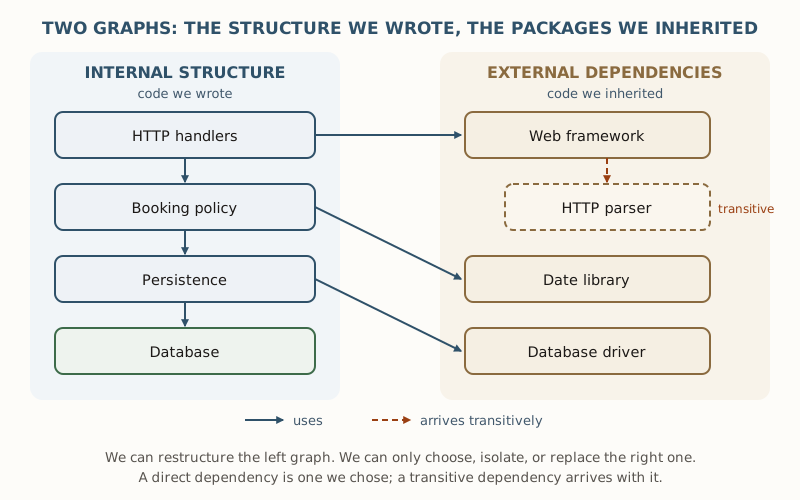
A dependency graph distinguishes direct dependencies, which an engineer selected, from transitive dependencies inherited through them. A software bill of materials (SBOM) records the components associated with a software artifact, usually with their versions and identifying information. These representations answer what is present, and which components a vulnerability, compatibility change, or maintenance decision reaches.
Evidence about a component is not yet a decision about it. Provenance mechanisms report where an artifact came from and how it was built; vulnerability scanners report selected known risks; release histories report whether anyone is still maintaining it. None of this establishes that the component is free of defects or malicious behavior, and none of it says what to do. Each question admits its own evidence and its own responses.
| Decision | Evidence required | Possible action |
|---|---|---|
| Is the component necessary? | Feature usage and dependency graph | Remove |
| Is it maintained? | Release history and maintainers | Retain or replace |
| Is it secure enough? | Vulnerabilities, mitigations, provenance | Upgrade or isolate |
| Is its license acceptable? | License and intended distribution | Retain or replace |
| Can we change it safely? | Compatibility and regression tests | Upgrade, fork, or migrate |
The licensing row carries obligations the other rows do not. Permissive licenses generally allow broad reuse subject to conditions such as preserving notices; copyleft licenses can impose further requirements on redistribution or derivative works, depending on the license and how components are combined. Identifying a license is not the same as determining the legal consequences of a particular use. The agent's proposal is the live case: LGPL-3.0 is weak copyleft, so what we owe on distributing to a second campus turns on how when-lib is linked and whether we modified it.
Every action in the table costs something. Updating a vulnerable library may require API changes; replacing it may introduce new defects; retaining it may leave unacceptable exposure. Return to the agent's proposal with that evidence in hand and the question is rarely approve or reject, but approve under which conditions — a pinned version, an isolating interface, a recorded licensing judgment, or a replacement already scoped.
Engineering confidence in a working system
The unit closes on three engineering questions, each answered through a model, and each model organizing a particular kind of evidence.
| Engineering question | Model | Evidence |
|---|---|---|
| Do we understand it, and did anyone record why? | Recovered structure, decision records, models of obligations | Can engineers explain the system and predict what a change touches? Are the constraints written down? |
| Can we afford the structure we have? | Recovered dependency graph, a cost model over a horizon | Change-impact probes, characterization and invariant tests, architectural checks |
| Can we rely on the components we inherited? | Dependency graph, SBOM, provenance records | Vulnerability, license, and provenance checks |
None of the three models makes its decision. Each reports a fact — what the team can and cannot explain, what anybody bothered to write down, where the coupling sits, what we are carrying and from whom — and the judgment that follows is economic rather than structural.
A working implementation establishes that selected behavior has been realized, not that the system can be safely changed. Tests, architectural rules, dependency policies, and release gates are what hold the obligations those models identify as the system changes. The next unit examines whether the system also meets quantitative requirements under realistic workloads and failures.
Labs
Lab 1 — The Architecture Workbench
The restructuring decision for the laboratory-reservation requirement. One service is drawn three ways — the structure as it stands, a modular monolith, and the policies extracted into separately deployed services — and you choose how many future changes to expect and whether laboratory changes must ship on their own. Two cost controls move independently: an implementation multiplier down to a hundredth, and a validation-and-integration level. The change scenario, the mix of future changes, and how many teams own booking policy are one disclosure away, under Further investigation. Commit a prediction for three conditions before the page will show you a number, then watch what the discount does and does not do. Driving implementation to a hundredth moves the point at which modularizing repays from four future changes to one, and never makes extracting services preferable at any horizon; that becomes the answer only when independent release is required, which is a constraint rather than a price. Two further things are worth your attention. The graph marks the components a change must modify differently from those it might reach, because a dependency edge does not establish that both ends change — for a storage change the modular structure has the smallest must-modify set and the widest possible-impact set, so a single count of affected components would rank it worst. And a rule editor lets you state what the structure must permit or prohibit and see where it fails, alongside three obligations no dependency rule can settle, which is the difference between describing an architecture and enforcing one. Every cost on the page is a declared assumption, not a measurement.
Exercises
Exercise 1 — Restructure the reservation service?
Your agent produced a working reservation service with weak internal boundaries, and an implementation probe confirms that the laboratory-policy change requires modifying four of its five components. More policy changes arrive each semester. In pairs, give a first answer — retain the current structure, refactor to a modular monolith, or extract services — and argue it from the expected changes rather than from the disorder you can see. Then perturb the premises: only one further policy change is ever expected; a second team takes over approvals. Which answers change, and why? The unit prices the three options afterwards and returns to this answer, so the first one is meant to be superseded.
Exercise 2 — Respond to a vulnerable dependency
The HTTP parser two levels down the dependency tree carries a critical CVE, and upstream is unmaintained. Five responses are on the table, each charging a different price — upgrade to a patched fork or major version and pay the compatibility testing; pin and mitigate, documenting the exposure window and the compensating control; replace the parser or the framework that chose it and pay the migration; remove the feature that pulls it in; or fork and maintain it, which means staffing a parser. Decide what you do tonight and what you do by next semester.
A critical CVE is not an exploit, so separate four questions before choosing. Is the vulnerable version present? Is the vulnerable functionality reachable from your deployment? Are the exploitation conditions satisfied? What is the consequence if it is exploited?
Materials
- Lecture slides — Technical Debt in Agentic Software Engineering — source (PPTX)
Readings
Three forms of debt in the age of AI
- Storey, "From Technical Debt to Cognitive and Intent Debt: Rethinking Software Health in the Age of AI" (ACM Queue 24:2, June 2026). Read the whole article. Storey argues that two kinds of deterioration deserve names alongside technical debt rather than being folded into it: cognitive debt, the erosion of a team's shared understanding of how its system works, and intent debt, the missing record of goals, constraints, and rationale that a later engineer or agent would need. The point to carry away is that the three reside in different places — the software, the people, the written record — and are therefore repaired by different work. Consider which of the three cheap agent-generated implementation grows fastest, and which of them your test suite can see at all. Full citation: Margaret-Anne Storey, “From Technical Debt to Cognitive and Intent Debt: Rethinking Software Health in the Age of AI,” Queue 24, no. 2 (2026), https://doi.org/10.1145/3807966.
- Tavantzis, Trinkenreich, Greiler, J. C. Araújo, M. C. Araújo, Santos, Serebrenik, Storey, and Baldassarre, "Cognitive Debt in the GenAI Era: Listening to Practitioners' Voices on the Loss of Understanding" (preprint, 27 October 2026; under review at ICSE-SEIP). Read the findings on how cognitive debt manifests and what practitioners do about it; the method section is optional. Reviewing 76 grey-literature sources, the authors report that cognitive debt accumulates behind working code and passing tests, particularly where AI-generated changes are accepted without the reviewer developing enough understanding to predict their consequences. The contribution is empirical rather than conceptual: practitioners already describe this failure, and they describe it as surfacing only once something must be changed or explained. Full citation: Theocharis Tavantzis et al., Cognitive Debt in the GenAI Era: Listening to Practitioners’ Voices on the Loss of Understanding, arXiv preprint arXiv:2610.37888; under review at ICSE-SEIP, 2026, https://arxiv.org/abs/2610.37888, the findings on how cognitive debt manifests and what practitioners do about it.
How architectural disorder emerges
- Foote and Yoder, "Big Ball of Mud" (1999). Read the introduction and the sections Big Ball of Mud, Throwaway Code, and Piecemeal Growth; the remaining patterns are optional. The authors explain why unstructured systems are so common: under schedule pressure and shifting requirements, each local decision can be individually reasonable while the accumulated structure loses its comprehensible boundaries. The point to carry away is that architectural disorder is usually the product of rational economics rather than incompetence — which is why the lecture treats restructuring as an economic decision. Consider whether inexpensive agent-generated code strengthens or weakens the pressures the authors describe. Full citation: Brian Foote and Joseph Yoder, Big Ball of Mud, laputan.org; originally presented at the Fourth Conference on Pattern Languages of Programs (PLoP ’97), 1999, https://www.laputan.org/mud/, introduction and the sections Big Ball of Mud, Throwaway Code, and Piecemeal Growth.
Technical debt as engineering judgment
- Fowler, "Technical Debt Quadrant" (2009). Read the whole article. Fowler separates deliberate from inadvertent debt and prudent from reckless decisions. The point to carry away is that technical debt can be an economically defensible choice rather than merely evidence of poor engineering. Consider how cheaper agent-generated implementation changes the cost of both taking on debt and repaying it. Full citation: Martin Fowler, Technical Debt Quadrant, martinfowler.com (bliki), 2009, https://martinfowler.com/bliki/TechnicalDebtQuadrant.html.
Evaluating inherited software
- OpenSSF Best Practices Working Group, "Concise Guide for Evaluating Open Source Software" (2025). Read the whole guide, concentrating on necessity, authenticity, maintenance, dependency management, security practices and practical evaluation. It gives an engineering procedure for deciding whether to adopt a dependency, rather than simply telling you to scan for known vulnerabilities, and it distinguishes evaluating a project's security practices from evaluating its suitability for your application. Full citation: OpenSSF Best Practices Working Group, Concise Guide for Evaluating Open Source Software, Open Source Security Foundation, 2025, https://best.openssf.org/Concise-Guide-for-Evaluating-Open-Source-Software.html.
Optional reference — the triple-debt argument in brief
- Storey, "How Generative and Agentic AI Shift Concern from Technical Debt to Cognitive Debt" (February 2026). Optional. The shorter essay that precedes the Queue article, and the source of the student-team example this unit uses: a team that built software rapidly with AI and, several weeks later, could no longer explain why its design decisions had been made or how the parts were meant to work together. Read it if you want the argument before it was formalized into the triple-debt model. Full citation: Margaret-Anne Storey, How Generative and Agentic AI Shift Concern from Technical Debt to Cognitive Debt, margaretstorey.com (essay), 2026, https://margaretstorey.com/blog/2026/02/09/cognitive-debt/.
Optional reference — service decomposition in depth
- Lewis and Fowler, "Microservices: A Definition of This New Architectural Term" (2014). Optional. Read the introduction and Componentization via Services if the lecture's modular-monolith-versus-services comparison leaves you wanting the service side in greater depth. The authors do not present microservices as universally preferable — they acknowledge the substantial costs of distributed coordination and the difficulty of changing service boundaries once established — which is the judgment the lecture asks you to exercise. This unit is about evaluating architecture after implementation, not about mastering any one pattern. Full citation: James Lewis and Martin Fowler, Microservices: A Definition of This New Architectural Term, martinfowler.com, 2014, https://martinfowler.com/articles/microservices.html, introduction and Componentization via Services.
Optional reference — identifying license obligations
- SPDX, "Handling License Info". Optional. Read the introductory material on the SPDX License List, short identifiers and license expressions, including combinations using AND, OR and WITH. It explains how licenses are identified and represented in machine-readable form — supporting material for the lecture's treatment of permissive and copyleft licensing, and not a substitute for understanding the obligations of any particular license. Full citation: SPDX, Handling License Info, SPDX (Linux Foundation), n.d., https://spdx.dev/learn/handling-license-info/, the SPDX License List, identifiers, and license expressions.