Delegating to Software Agents: Old Problem, New Properties
Premise. Delegation is an engineering decision shaped by the work, the recipient, and the consequences.
Software agents combine properties of two familiar recipients of delegated work. Like people, they can reason, adapt, and act under circumstances that were not completely specified in advance. Like deterministic automation, however, they cannot assume responsibility for the consequences of their actions. We can delegate work to an agent; we cannot delegate responsibility to it.
Earlier, we defined engineering as the discipline of exercising informed control over consequential systems and accepting responsibility for their outcomes. That does not require engineers to personally perform every act of realization. It requires them to retain responsibility for the resulting system.
Delegation is not new. Software engineers delegate to colleagues, contractors, libraries, compilers, and other automation. Factories did the same long before software: engineers delegated fabrication to skilled machinists while drawings, tolerances, gauges, and inspection preserved control over the result. Nursing provides another consequential setting in which work is deliberately assigned according to the capability of the recipient, the consequences of the task, and the supervision available.
Across these settings, the recipient changes but the delegation problem persists: what work should be handed over, what does the recipient need, what consequences may it produce, and what evidence justifies accepting the result?
Software agents introduce a new recipient: probabilistic automation capable of reasoning and acting over time. Their capabilities and costs differ substantially from both people and deterministic automation, but the engineering problem of delegation remains.
| another person | deterministic automation | probabilistic automation | |
|---|---|---|---|
| reliability | depends on skill and care; may fudge, or claim competence not held, and may not recognize that a situation is unfamiliar | exact and repeatable within its specification; systematically wrong when the specification is wrong | depends on model strength and context; produces fluent work whether or not it is correct |
| unforeseen circumstances | can adapt, but recognizing novelty itself takes expertise | has no independent judgment for novel circumstances | can reason about novelty, but may fail to recognize or handle it correctly |
| what the delegator supplies | instruction, context, and review | a specification, once | instruction, context, and review — re-supplied each engagement |
| memory | learns durably; knowledge accrues in the person | does not learn, but is memory — the check encodes it permanently | carries memory as session state, externalized files, and weights; the durable part is what was externalized by design, and the internal part is not interpretable |
| accountable? | yes | no | no |
| cost shape | low setup, high per unit | high setup, near-zero per unit | low setup, low but non-zero per unit |
This unit asks how to make that delegation an engineering decision. An agent's engineering capability is not a property of the model alone. What an agent can accomplish depends on the model, the harness through which it acts, the engineering environment in which the work occurs, and how the work itself is structured.
Delegation is therefore a system-design problem: bound the work, equip the agent, authorize its actions, and verify the result.
BOUND → EQUIP → AUTHORIZE → VERIFY
These are not rigid stages. They are four questions an engineer must answer when delegating consequential work. What work should the agent perform? What does it need in order to succeed? What consequences should it be permitted to produce? What evidence will justify accepting the result?
The rest of this unit develops the engineering levers available for answering those questions. We study contemporary mechanisms — context management, tools, MCP, skills, memory, permissions, and work decomposition — for the engineering purposes they serve, rather than the details of particular products.
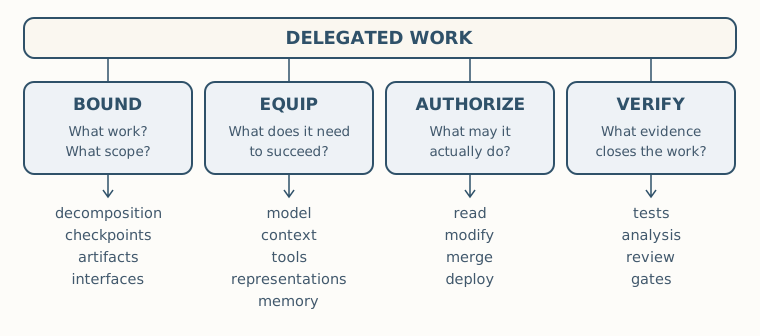
Capability is designed across model, harness, and environment. Authority and evidence determine which consequences that capability may produce.
The Master Equation¶
The Master Equation separates places where reliable delegated realization can fail.
pR = P(E | R) · P(I | E, R) · P(L | I, E, R)
The Act II overview shows how all four units use this decomposition. This unit begins with the surrounding delegation problem: how should an engineer design the work, capability, authority, and evidence around a probabilistic realization?
The subsequent units examine this system from three directions. Modeling asks how consequential knowledge should be represented so that it can be encoded and interpreted reliably while leaving irrelevant realization choices free. Alignment asks which obligations should be backed by controls outside the producing reasoner's judgment. Failure-Aware Engineering then asks what observed failures reveal about the system we designed.
The equation is not a recipe for calculating a number. It identifies where reliability comes from. A stronger reasoning model cannot repair missing intent; a better representation cannot supply missing means; and high capability does not justify unlimited authority. Delegation means engineering the whole system around the reasoner.
Where does capability live?¶
An agent's capability emerges from three layers:
- The model interprets information, reasons, and generates candidate actions or artifacts.
- The agent harness turns that reasoning into sustained action by managing context, state, tools, feedback, and continuation across steps.
- The engineering environment supplies the artifacts and systems in which the work occurs: repositories, specifications, engineering models, tests, build and deployment systems, and organizational knowledge.
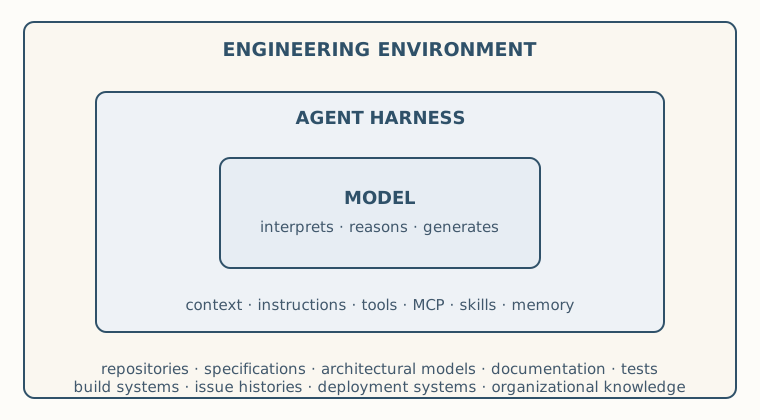
The layers interact: the harness determines what reaches the model and what it can do; the environment determines what knowledge and mechanisms are available; the model bounds the reasoning.
These layers determine the capability available for delegated work. They do not determine what work should be delegated, what authority the agent should receive, or what evidence should be required before its work is accepted.
Equip the agent¶
Within this system, engineers have three broad ways to equip the agent for the bounded work:
| Equip | Engineering purpose | Examples |
|---|---|---|
| Reasoner | Select the underlying reasoning capability | frontier, low-cost, specialized, open-weight models |
| Information | Make relevant knowledge and state available to the reasoner | context, instructions, retrieved knowledge, memory, representations |
| Means | Give the agent ways to observe, act, and carry out recurring work | tools, APIs, MCP connections, skills, workflows |
These interventions solve different problems. A stronger reasoner does not supply missing information; more context does not provide a missing capability to act; a tool does not establish that its use is authorized. Diagnose what the delegation lacks before deciding how to equip it.
Bound the work¶
Delegation begins by deciding what work the agent should perform and what choices it may resolve. A task that is too broad may require more relevant state than the agent can reason about effectively; one divided too finely may force important relationships to be repeatedly reconstructed across task boundaries.
An agent's reasoning horizon is the amount of relevant state it can effectively bring to bear on a task. Engineers can move work within that horizon by narrowing its scope, choosing better boundaries, retrieving relevant context, externalizing state, supplying tools, or providing representations that make important relationships easier to reason about. A dependency model, for example, may expose relationships that the agent could otherwise reconstruct only by examining thousands of source lines.
The objective is not the smallest task or the largest context window. It is a tractable reasoning surface: enough freedom for the agent to perform coherent work without requiring consequential relationships to be repeatedly reconstructed. When the same knowledge must be recovered again and again, that is evidence that the engineering environment may need to represent it explicitly.
Delegation therefore leaves some degrees of freedom for the recipient to resolve. Greater capability may let engineers leave more choices open. Deciding which choices to delegate remains an engineering decision.
Capability is not authority¶
A model responds to an invocation; an agent acts over time. The harness creates that difference, and tools confer authority as well as capability. Consider the same capable coding agent under five grants of authority:
read repository → propose patch → modify branch → merge → deploy
Its underlying reasoning capability may be unchanged. What changes is the consequence it is permitted to produce. Authority is therefore an engineering variable independent of capability.
Instructions can make desirable behavior more likely. They do not restrict what an authorized action can cause or establish that the resulting artifact is acceptable.
Verify the result¶
Delegating realization does not delegate responsibility for deciding whether its result is acceptable. Before the work begins, engineers should therefore ask what evidence will be required to close the delegation. A generated patch might require tests and review; an architectural change might require evidence about dependency or performance consequences; a deployment might require stronger checks because its consequences are immediate and difficult to reverse.
The required evidence depends on the claims and consequences of the work, not on whether a human or an agent produced it. Nor should the agent's own judgment that its work is correct generally be confused with independent evidence for that claim. Later units develop how engineering environments can evaluate such obligations and control what happens when they are violated.
Engineer the whole system¶
BOUND → EQUIP → AUTHORIZE → VERIFY. These decisions interact. Better representations or a more capable model may permit broader delegation; narrower authority or stronger verification may make greater autonomy acceptable. The engineering object is not the agent alone but the system in which delegation occurs.
What changes as agents improve?¶
Contemporary agents still require substantial engineering around their reasoning: task boundaries, external context and representations, tools, permissions, and independent checks. Those needs are changing as agents become better at sustained reasoning, independent progress, tool use, constructing useful representations, and evaluating their own work.
Suppose those capabilities improve substantially. What changes about BOUND → EQUIP → AUTHORIZE → VERIFY? What stays the same? If agents can construct the representations they need and evaluate their own work, what knowledge and control must still exist outside the agent?
Materials¶
- Lecture slides — Delegating to Software Agents: Old Problem, New Properties — source (PPTX)
Readings¶
Delegation and responsibility
- Bainbridge, "Ironies of Automation." Read the opening and §1 only (pp. 775–76 of the course copy), stopping at §2. The paper asks what remains for people when routine work is automated; the residue may be the work the human is least prepared to do. Ask what remains with the engineer once routine realization is delegated, and what capability it requires. Full citation: Lisanne Bainbridge, “Ironies of Automation,” Automatica 19, no. 6 (1983): 775–79, https://doi.org/10.1016/0005-1098(83)90046-8, opening and §1 only (pp. 775–76), stopping at §2.
- ANA and NCSBN, "National Guidelines for Nursing Delegation." Read pp. 1–9, with special attention to the Five Rights of Delegation on p. 4: another profession's framework for bounded delegation with retained accountability. Consider what changes when the delegatee is a software agent that cannot itself be accountable. Full citation: American Nurses Association and National Council of State Boards of Nursing, National Guidelines for Nursing Delegation, Joint Statement (2019), https://www.nursingworld.org/globalassets/practiceandpolicy/nursing-excellence/ana-position-statements/nursing-practice/ana-ncsbn-joint-statement-on-delegation.pdf, pp. 1–9; special attention to the Five Rights, p. 4.
Bound and equip the work
- Pólya, How to Solve It. Read Part I, §§6–9 (PDF pp. 14–17 of the course scan), with "Draw a figure," "Working backwards," "Decomposing and recombining," and "Use a problem related to yours." Pólya improves reasoning by changing the problem presented to the reasoner; read his techniques as ways of moving work within the reasoner's effective reasoning horizon. Full citation: George Pólya, How to Solve It: A New Aspect of Mathematical Method, 2nd ed. (Princeton University Press, 1957), Part I, §§6–9 and selected dictionary entries.
- MAGE §7.1, "The Reorganization of Software Work." Davis, 2026. Read §7.1.2 and §7.1.4 only. Together they locate agent capability in the larger engineered environment and ask where engineering effort moves as implementation becomes cheap. Read the pair against this unit's question: where does the capability for delegated work live? Full citation: James C. Davis, Model-Based Agentic Engineering, 1st ed. (2026), https://davisjam.github.io/model-based-agentic-software-engineering/book/mage-book/index.html, §7.1.2 and §7.1.4.
Engineer the environment
- Claxton, "The AI-Native SDLC Playbook." A contemporary practitioner account of engineering around software agents, published by the maker of the tools it recommends rather than as controlled evidence. Read it as a collection of practices to classify using BOUND → EQUIP → AUTHORIZE → VERIFY, rather than as prescriptions to accept. Full citation: Louis Claxton, “The AI-Native SDLC Playbook,” Anthropic, August 21, 2026, https://claude.com/blog/the-ai-native-sdlc-playbook.
- The Software Engineering Handbook, Chapter 4, "Engineering Knowledge." Davis, 2026. Read the full chapter. It treats engineering knowledge as something the environment can retain, so that each human or machine reasoner need not reconstruct it anew. Full citation: James C. Davis, The Software Engineering Handbook: A Judgment and Decision-Making Approach, 1st ed. (2026), https://davisjam.github.io/model-based-agentic-software-engineering/book/se-handbook/index.html, chap. 4.